Pauline Boty features in newly-published “British Blonde: Women, Desire and the Image in Post-War Britain” by Lynda Nead

“British Blonde: Women, Desire and the Image in Post-War Britain” by Lynda Nead. Jacket Image: Pauline Boty backcombing her hair in ‘Pop Goes the Easel’, Monitor (BBC Television, 1962; dir. Ken Russell), frame still. © BBC

Published on 9th September, British Blonde: Women, Desire and the Image in Post-War Britain by Lynda Nead gives “a vivid account of the atmosphere and culture of postwar Britain, explored through the image of the British Blonde.” The book is published by the Paul Mellon Centre.

From the Yale University Press website: “In the 1950s, American glamour swept into a war-torn Britain as part of a broader transatlantic exchange of culture and commodities. But in this process, the American ideal of the blonde became uniquely British—Marilyn Monroe transformed into Diana Dors.

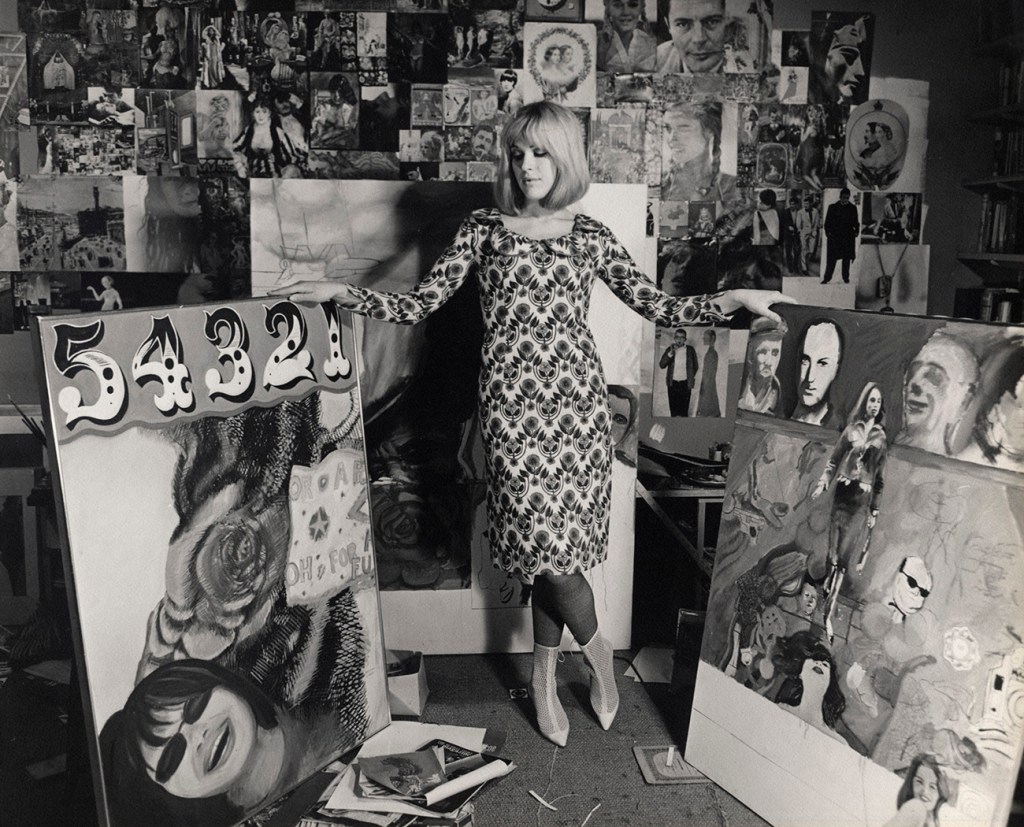
Michael Seymour, Pauline Boty, 1962, R-type colour print, 26 x 38.5 cm. National Portrait Gallery, London (NPG x88193). © Michael Seymour. From “British Blonde: Women, Desire and the Image in Post-War Britain” by Lynda Nead.

British Blonde examines postwar Britain through the changing ideals of femininity that reflected the nation’s evolving concerns in the twenty-five years following the Second World War. At its heart are four iconic women whose stories serve as prompts for broader accounts of social and culture change: Diana Dors, the quintessential blonde bombshell; Ruth Ellis, the last woman to be hanged in Britain; Barbara Windsor, star of the Carry On films; and the Pop artist Pauline Boty. Together, they reveal how class, social aspiration, and desire reshaped the cultural atmosphere of the 1950s and 1960s, complicating gender roles and visual culture in the process.
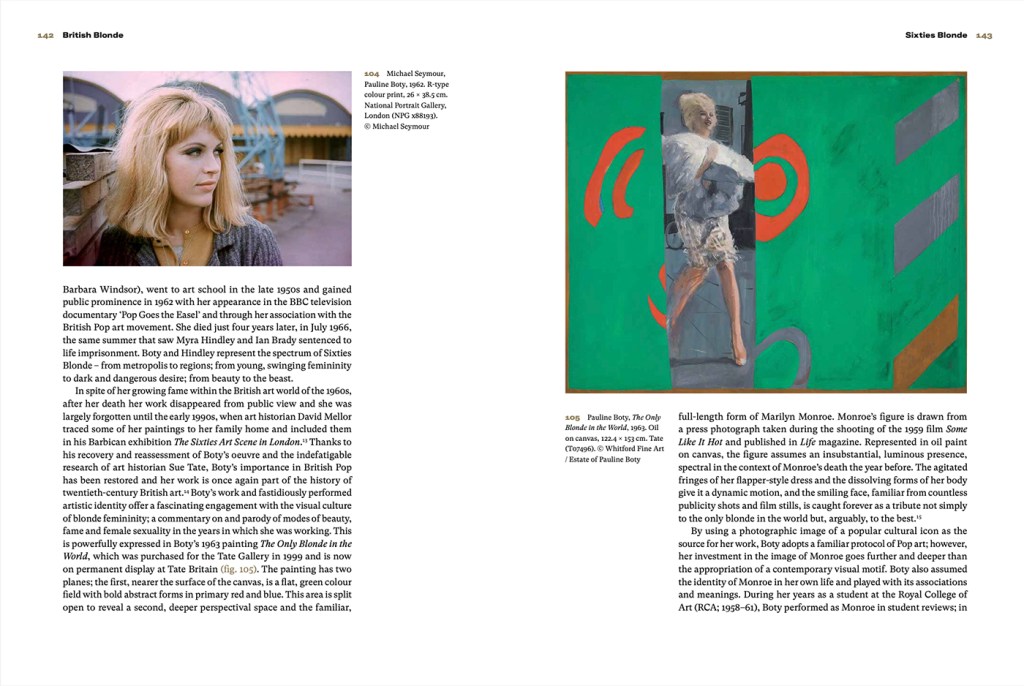
Spread from“British Blonde: Women, Desire and the Image in Post-War Britain” by Lynda Nead.

Richly illustrated with paintings, photography, film stills, and advertisements, this interdisciplinary and engagingly written study offers a highly original perspective on an era that transformed Britain’s visual and cultural identity.”

Lynda Nead will be giving a talk at the Victoria and Albert Museum on 23 October. Further information is available here: [link]

Imprint: Paul Mellon Centre 
Format: Hardback 
ISBN: 9781913107499
Dimensions: 254 x 190mm
Pages: 240
Illustrations: 143 colour + b-w
Price: £30
Further information on the book is available here: [link]
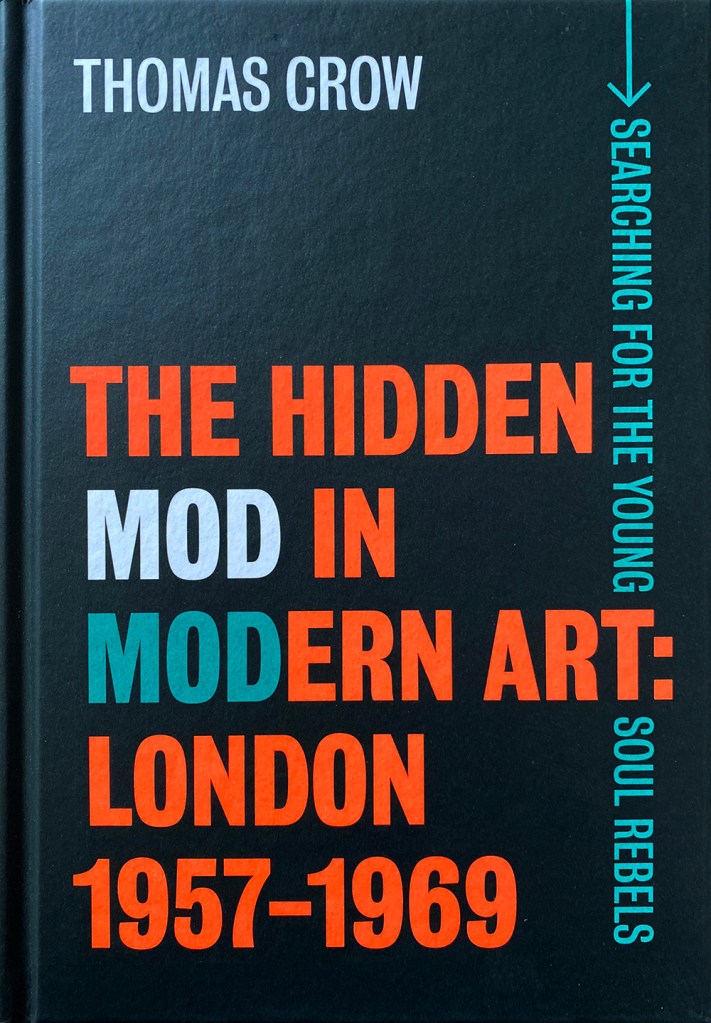
“The Hidden Mod in Modern Art” with chapter on Pauline Boty and Bridget Riley is published on 13th October

“The Hidden Mod in Modern Art: London, 1957-1969” by Thomas Crow.

“The Hidden Mod in Modern Art: London, 1957-1969” by Thomas Crow looks into the considerable influence of the Mod subculture on key figures of the 1960s British art scene. One of its six chapters is devoted in its entirety to Pauline Boty and Bridget Riley, including a fascinating account of the former’s association with John Schlesinger and his films Billy Liar and Darling. The book is published by the Paul Mellon Centre.

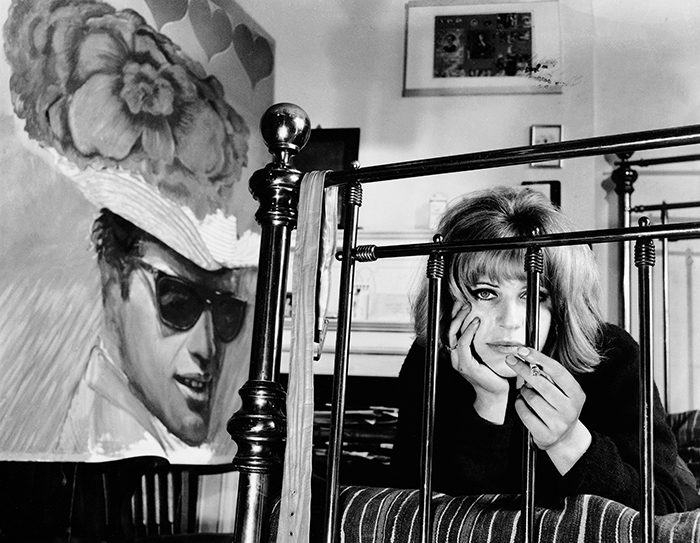
Pauline Boty, photographed by Lewis Morley, 1963. Bromide print, 29.3 x 35.6 cm. National Portrait Gallery, London

From the Yale University Press website: “Bonding over matters of taste and style, the ‘Mods’ of late 1950s London recognised in one another shared affinities for Italian-style suits, tidy haircuts, espresso bars, Vespa scooters and the latest American jazz.
In this groundbreaking book, leading art historian Thomas Crow argues that the figure of the Mod exerted an influence beyond its assumed social boundaries by exemplifying the postwar metropolis in all of its excitement and complexity. Crow examines the works of key figures in the London art scene of the 1960s, including Robyn Denny, David Hockney, Pauline Boty, Bridget Riley and Bruce McLean, who shared and heightened aspects of this new and youthful urbanity.
The triumphant arrival of the international counterculture forced both young Mods and established artists to reassess and regroup in novel, revealing formations. Understanding the London Mod brings with it a needed, up-to-date reckoning with the legacies of Situationism, Social Art History and Cultural Studies.”

Imprint: Paul Mellon Centre 
Distribution: Yale University Press
Format: Hardback 
ISBN: 9781913107130
Dimensions: 241 x 165mm
Pages: 200
Illustrations: 140 colour + b-w illustrations
Price: £25

New study of 1960s London art world including Pauline Boty is published on 9th June

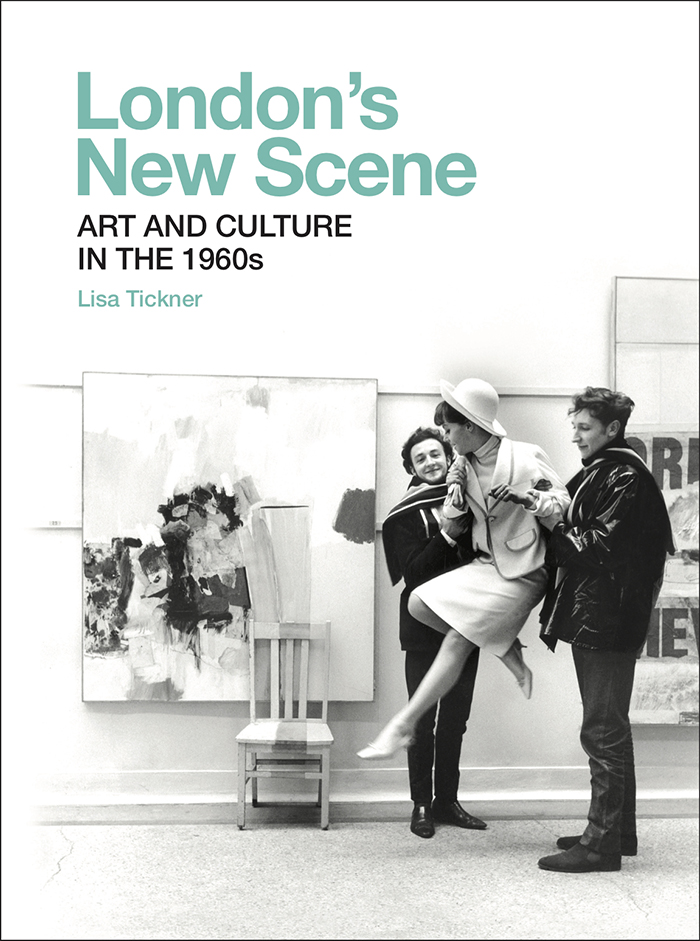
“London’s New Scene: Art and Culture in the 1960s” by Lisa Tickner. Cover photo: 4th April 1967: Fab Pop Bash with Rauschenberg © Elsbeth Juda

In London’s New Scene: Art and Culture in the 1960s Lisa Tickner presents a sequence of critical case studies, each of which explores a particular institution or event in the cultural life of London between 1962 and 1968. Each chapter takes a particular topic as its focus – these include Ken Russell’s film Pop Goes the Easel (1962), the opening of the Kasmin Gallery (1963), the first of the New Generation exhibitions and Painting and Sculpture of a Decade: ’54-’64 at the Whitechapel and Tate Galleries (1964), Lord Snowdon’s photographs of artists in Private View (1965), Antonioni’s London film Blow-Up (1966), and more. The book treats a film, a gallery, an exhibition, a book, a protest, as itself a ’work’: as a creative project in its own right, built from the resources to hand, subject to the pressures of the moment, comparable in its own way to the art it draws on or frames.

Page 44 /fig. 32 Pauline Boty, 1963. Photograph by Jorge Lewinski, Private collection © The Lewinski Archive at Chatsworth/Bridgeman Images

The illustrations include art works by David Hockney, Peter Blake, Derek Boshier, Pauline Boty, Bridget Riley, John Latham and Barry Flanagan, photographs by David Bailey, Ida Kar, Jorge Lewinski and Lord Snowdon, and a wide range of film stills, gallery installation shots, advertisements and press photography.” [information courtesy of Yale University Press]

SPECIFICATIONS
Publisher: Paul Mellon Centre
Distribution: Yale University Press
Format: Hardback
Size: 256 x 192mm
Pages: 424pp
Illustrations: 200/80 colour
ISBN: 9781913107109
Price: £35

More information available here [link]