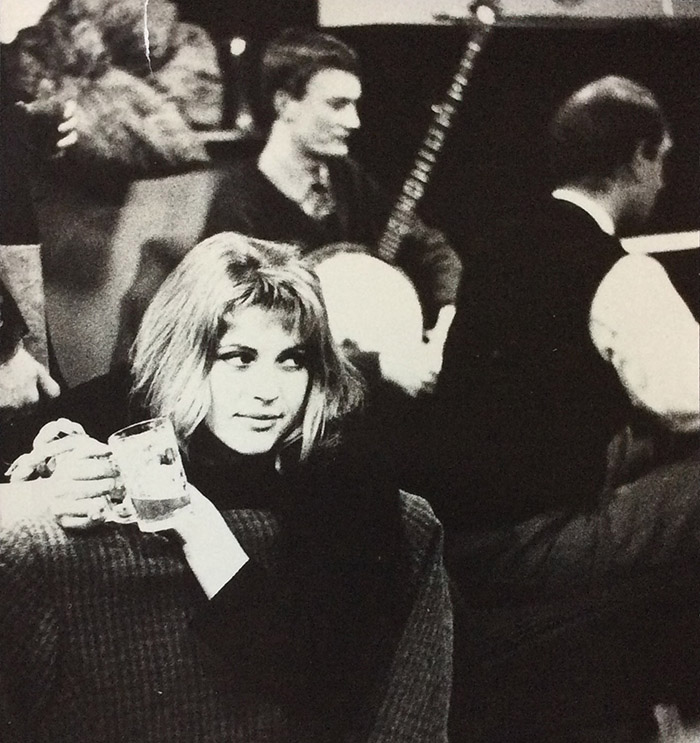
Paulineboty.org is honoured to show the photo above for the first time. It was taken by Boty’s friend and fellow Royal College of Art student Geoffrey Reeve in the college’s Junior Common Room, which was originally on the first floor on the corner of Cromwell Place and Cromwell Road opposite the Natural History Museum in South Kensington. Behind Boty can be seen John Watson and Alan Cooper of The Temperance Seven rehearsing. The 1920s-style jazz band, formed at the RCA during 1957, had a UK #1 hit single in 1961 with “You’re Driving Me Crazy” produced by George Martin followed by “Pasadena”, which reached #4. More information on them can be found here [link]
Earlier this month the gouache on card work, created by Boty when a student at the Royal College of Art, sold for double its high estimate. The following image and details are all courtesy of Christie’s:
Produced in the first year of her studies at the RCA, this design already demonstrates Boty’s breadth of interests and talent for creative juxtapositions. The proportions and diptych arrangement seem made for church windows, but the content is far from ecclesiastical. Instead, the design features a dreamlike mix of architectural elements and a large letter ‘L’ framing figural elements including heads (painted frontally and in profile), and two lovers locked in an embrace. The assembly of disparate elements into a cohesive whole foreshadows Boty’s later Pop Art paintings and collages. It also reflects the influence of Charles Carey, who first taught Boty stained glass design at the Wimbledon Art School, and who encouraged students to use collage during the design process as a means of adding contemporary elements to an ancient artform.
Pauline Boty was a polymath who entered the Royal College of Art in 1958 to study stained glass design but became a leading light in the nascent Pop Art scene alongside contemporaries including Peter Blake and Derek Boshier. In this guise she produced paintings and collages which blended abstract elements with a profusion of imagery poached from pop culture, with surreal and often satirical results. She was also heavily involved with film and literature societies and agitated against some of the more egregious examples of contemporary architecture in London as a key organiser for the ‘Anti Uglies’.
Provenance The artist’s family. Private collection, London. Purchased by the present owner at the 2016 exhibition
PAULINE BOTY (1938-1966) Designs for stained glass window gouache on card 9 ¼ x 3 in. (23.5 x 7.6 cm.) each Executed circa 1958
Literature Exhibition catalogue, Pop Art Heroes Britain, London, Whitford Fine Art, 2016, pp. 26–27, no. 13, illustrated
Exhibited London, Whitford Fine Art, Pop Art Heroes Britain, May – July 2016, no. 13
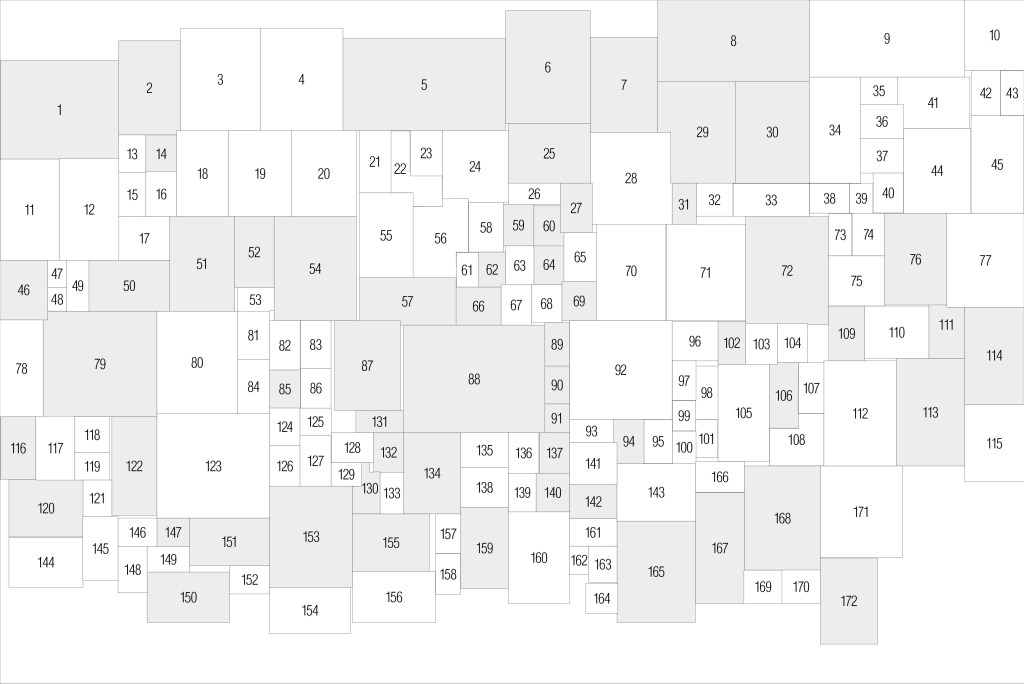
Pauline Boty: collaged wall key for 1964 Roger Mayne photo, v2, March 2021
The collaged wall created by Pauline Boty and photographed by Roger Mayne in 1964 has now been added to the site together with the numbered key shown above identifying some 60 items so far. As stated on the page, it is greatly hoped that this will provide a starting point for identifying the array of items chosen by Boty to adorn the wall, and that in time more of them will be identified and the list expanded further. All comments, corrections, clarifications and suggestions from visitors to the site in this regard would be greatly appreciated, via the Contact form here: [link] The new page can be accessed here: [link]
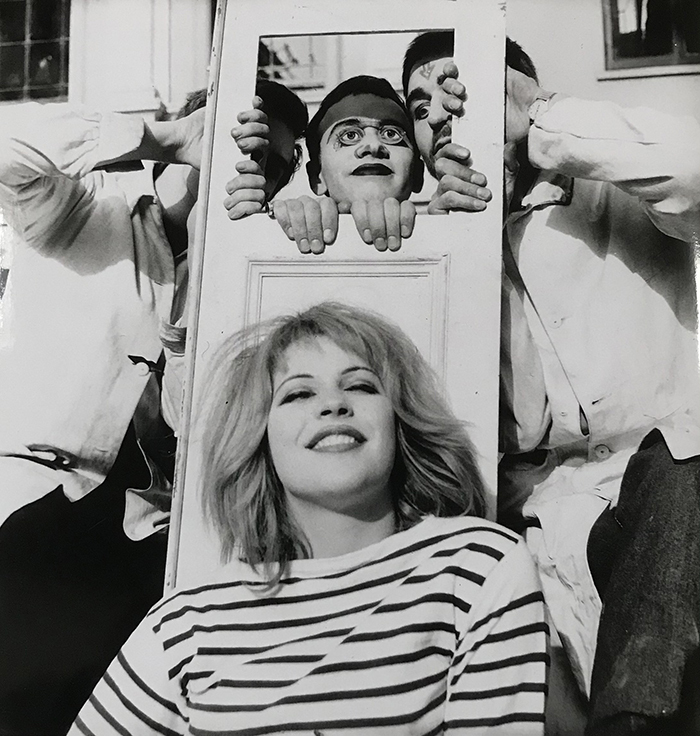
The first of a number of new images of Pauline Boty has been added to the website thanks to the generosity of one of her friends and fellow RCA students, Geoffrey Reeve, who also co-exhibited his paintings in the pioneering exhibition Blake, Boty, Porter, Reeve at the AIA Gallery in 1961. Pictured below is Boty with fellow students from the stained glass department, photographed by Reeve for an article entitled “It’s Magic” in ARK 33 magazine, Autumn 1962. Further of his portraits of Boty and her contemporaries will be shown in due course on the site via In Focus>Photos, changing on a regular basis. Over 30 of Reeve’s photos are available to license from Bridgeman Images for personal, presentation and editorial use here: [link]
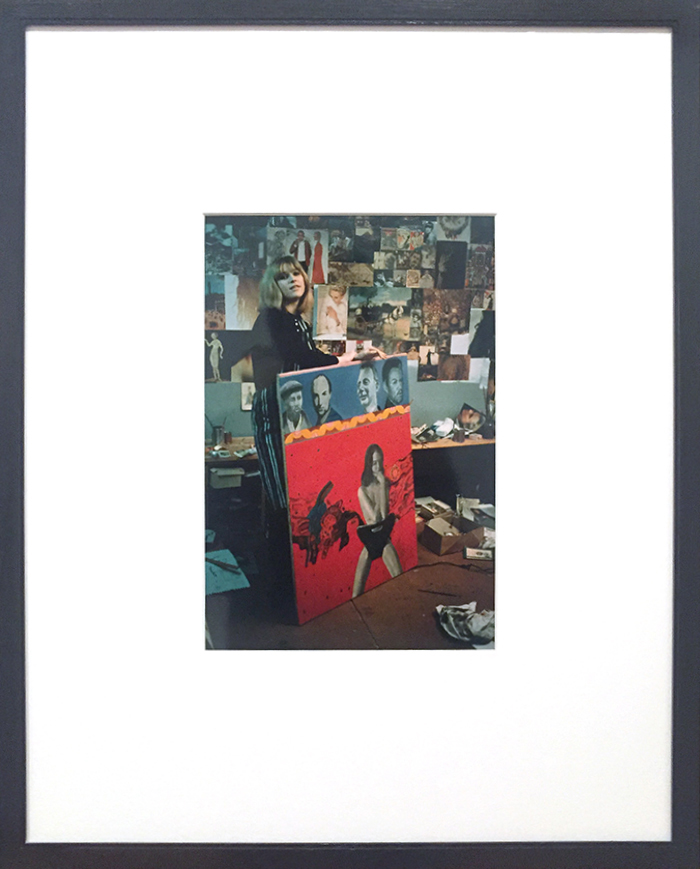
Pauline Boty by Michael Ward, 13 January 1964, C-type colour print
The portrait of Pauline Boty with her presumed lost work “Scandal ’63” is on display in “The UK 1960–Today” in Room 32 at the National Portrait Gallery.
“The display includes groups of portraits by particular artists, inviting the viewer to consider the range of contrasting approaches. While the challenge of depicting an observed sitter remained, a rich stylistic diversity characterises portraiture in the late 20th and early 21st centuries.
From the early 1960s the pace of social, political and artistic change in Britain gathered momentum. Food rationing ended only in 1954 and a growing affluence and a new mood of prosperity gave rise to increasing consumerism. Television, cinema, radio, advertising and magazines fuelled these changes by swiftly communicating the latest developments in fashion, design, music, science and the arts. But the optimism of the early 1960s was, by the end of the decade, replaced by a sense that the dream of progress had somehow slipped away. Throughout the 1970s and 1980s inequality in material wealth increasingly created new hierarchies and social tension.” [from the National Portrait Gallery website]
With thanks to Terence Pepper for the notification. More information on the portraits on display can be found here: [link]
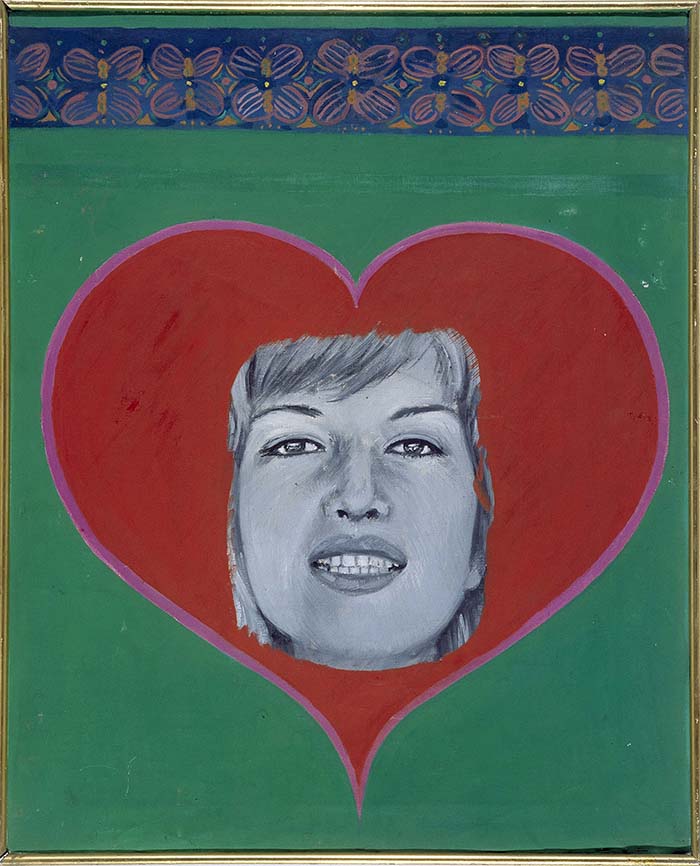
This new section lists some of the sources for titles of Pauline Boty’s paintings such as “Monica Vitti with Heart” shown below. In future the intention is to expand it further and also add information on the content she included, such as the names of individuals featured in the works. Access the new section here [link]