The key above for the different individuals and objects assembled by Pauline Boty in one of her most important collages – the c. 1960/61 work “Picture Show” – is part of a new page recently added to the site. Thanks to Boty’s preproduction interview for and commentary during Ken Russell’s 1962 BBC documentary “Pop Goes the Easel”, we have a record of her inspiration behind creating the collage and descriptions of some of its sources, including Franklin D. Roosevelt, Proust, Marilyn Monroe and Colette. With most of the contents identified, it is hoped that in time the rest of the items can be also and the list on this page completed. The new page can be accessed here: [link]
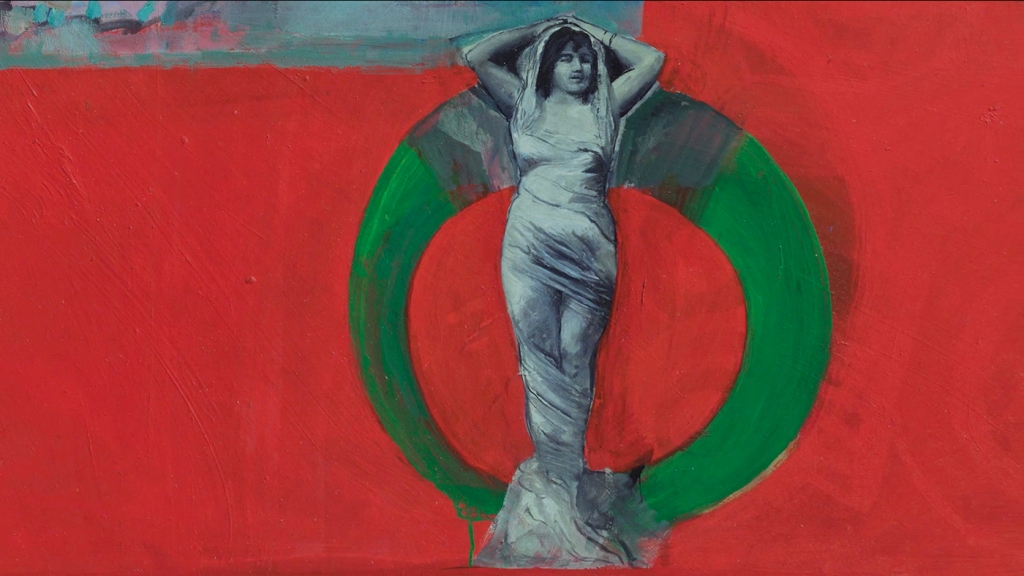
Pauline Boty (1938-1966), 1962, Epitaph to Something’s Gotta Give [detail], oil on board (estimate: £500,000-800,000). Christie’s Images Ltd. 2024.
Pauline Boty’s tribute to Marilyn Monroe, Epitaph to Something’s Gotta Give was exhibited at the Arthur Jeffress Gallery in August 1962, and gifted by the artist to a close friend two years later. It has remained in the same collection ever since.
Christie’s Modern British and Irish Art specialist Angus Granlund says the gift marked a key moment in Boty’s career: “A trailblazing pioneer and true polymath, Boty painted, acted, danced and engaged in political activism. However, at this key period she refocused her energy on painting, turning down acting roles to do so.” Granlund further describes the work as “a hugely important picture, and Boty’s only Marilyn painting still in a private collection. It unites two women who were synonymous with one another in the 1960s.”
Epitaph to Something’s Gotta Give (1962, estimate: £500,000-800,000), is a leading highlight of the Modern British and Irish Art Evening Sale on 20 March.
Ali Smith inspecting Epitaph to Something’s Gotta Give in the short film accompanying the lot essay. Christie’s Images Ltd. 2024.
The essay and short film with Ali Smith are available here: [link]
Lot detail Epitaph to Something’s Gotta Give, 1962 Oil on hardboard 106.5 x 127 cm
Estimate GBP 500,000-800,000
Auction details Modern British and Irish Art Evening Sale 20 March 6:30PM GMT | Live Auction 22673
Viewing New York: from 9–21 February London: from 13–20 March
Further information on the auction is here: [link]
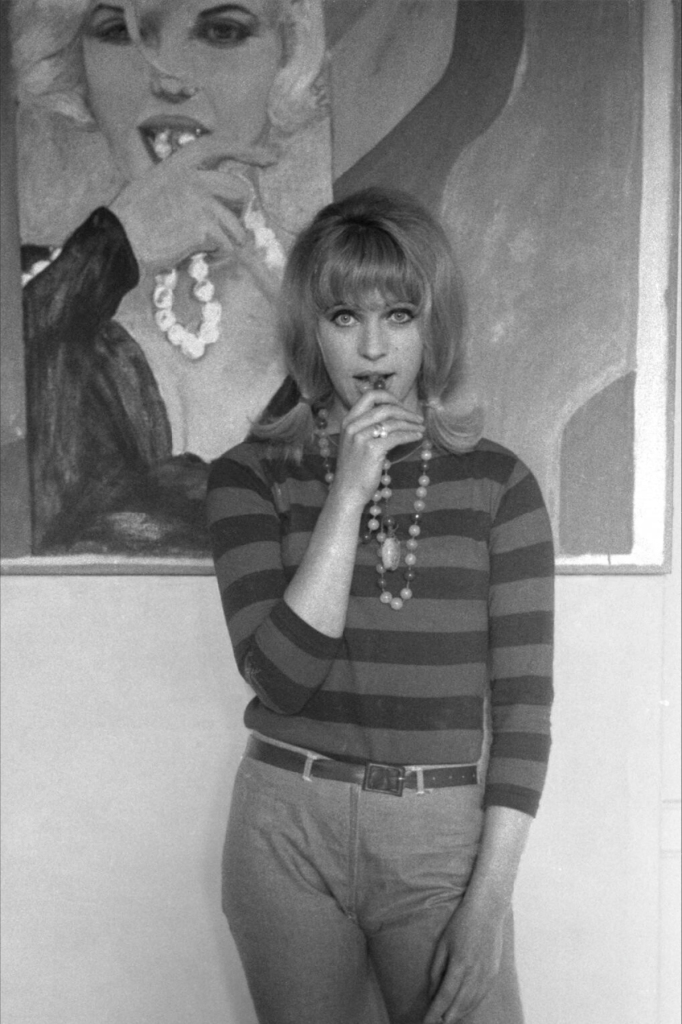
When originally compiling the list of Boty’s paintings for this website I consulted Dr Sue Tate as to whether I should include the “Marilyn with Beads” that Boty is photographed with by John Aston in a print owned by the National Portrait Gallery. Tate was adamant the work no longer existed as she felt sure that Boty had chosen to overpaint it with Colour Her Gone, citing the likelihood that the artist was unhappy with the somewhat crude and overlarge rendering of Monroe’s hand holding the beads – and so it has always been listed accordingly here.
John Aston was commissioned by Men Only to photograph Boty for a feature entitled “Pauline Goes Pop” in the March 1963 issue, ultimately returning for a second session as the first set of prints he showed the magazine wasn’t deemed suitable for its readership.
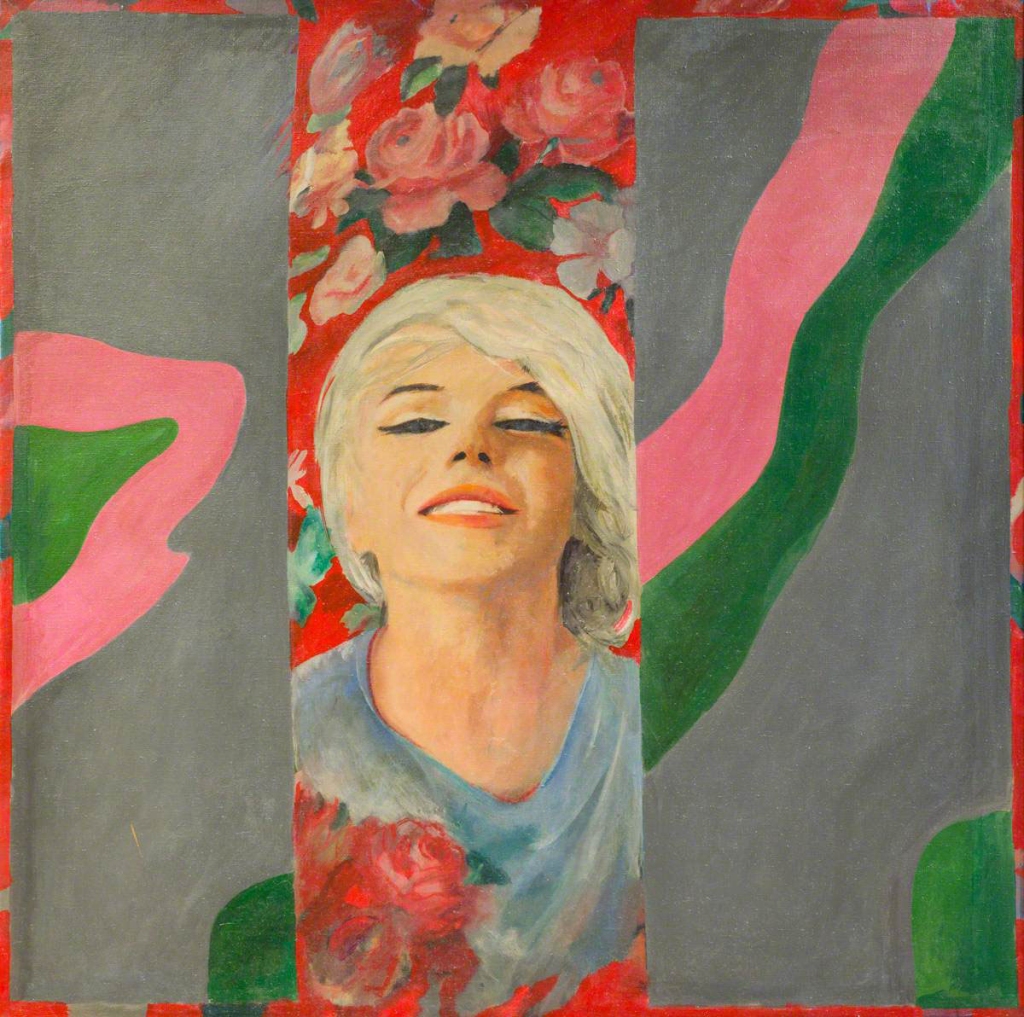
Having had the chance to look again at Colour Her Gone at Gazelli Art House for the first time since 2013 at the exhibition “Pauline Boty: Pop Artist and Woman”, it occurred to me to see what would happen if I montaged the two images together in Photoshop. As per the first image above, the abstract panels looked to me to match nigh on identically, with the central figurative area of the painting maintaining the same width to support Tate’s assertion and I provided Wolverhampton Art Gallery and Gazelli with printouts to propose the theory.
Happily, the two galleries chose to jointly commission a detailed analysis of the work, resulting in the recent announcements from Gazelli Art House and news article from Artnet:
“Exciting news involving Gazelli Art House, Wolverhampton Art Gallery, paulineboty.org, and Dr Sue Tate was recently revealed during Gazelli’s book launch and talk on 23rd January 2024. Together with Wolverhampton Art Gallery, Gazelli Art House conducted a reflectogram (an image taken from beneath an artwork’s surface) validating the ongoing research efforts led by Dr. Sue Tate and Christopher Gregory (paulineboty.org). In a stunning revelation, an entirely new narrative for Pauline Boty’s famed painting Colour Her Gone (1962) has come to light. A reflectogram has shown the iconic portrait of Marilyn Monroe was painted over an earlier image of the star, Marilyn with Beads. This was long thought to be a lost painting, and can be traced back to a 1962 photograph by John Aston. Boty’s Pop Art aesthetic, characterised by broad brushwork and flat perspective, initially suggests a straightforward technique, however reflectography has exposed the intricate evolution of the composition. Painted alterations, particularly to the top of the right-hand colour field panel and the central green ribbon, indicate contemporaneous changes, suggesting a wholesale repainting of the artwork. Pentimenti (visible traces of earlier painting beneath painted layers), showcasing shifts in pearl positions and nostril locations, reflect the artist’s organic design approach. Overall, infrared reflectography (IRR) indicates not just changes in colour panel forms but also hints at alterations to colours used. The transparency of the green upper design in infrared suggests a different initial colour, opening avenues for exploration into pigment variations. The reflectogram invites a closer examination of this artistic transformation, offering a unique glimpse into the complex layers of Colour Her Gone. Colour Her Gone was lent to Gazelli Art House for Pauline Boty: A Portrait (2023-24) by Wolverhampton Art Gallery.
Colour Her Gone; by Pauline Boty, 1962, oil on canvas
‘I had long thought that Marilyn with Beads was not a lost work but lay under Colour Her Gone. The reflectogram gives us conclusive evidence. Here as in other paintings Boty has radically reworked a composition until she had clinched the image that expressed exactly what she wanted to say”. The reflectogram also allows to see, as the report states, “the highly complex development of the composition” and “a high level of planning”, refuting criticisms of slapdash work.’ — Dr. Sue Tate, Freelance Art Historian”
As a footnote both Boty’s source image of Monroe from Town magazine and the paintings’s title originate from the same month of November 1962. In the latter case it was the release date of the single My Colouring Book by among others, Barbra Streisand, with its original closing refrain of “Colour him gone”. Clearly the song made an impression on the artist as she took its title to name another of her works, also including typed fragments of its lyrics, applied using Letraset.
Town magazine, November 1962, published by Corrmarket Press. Cover photo of Marilyn Monroe by George Barris
To see Artnet’s write-up of the report’s confirmation, please see here: [link]
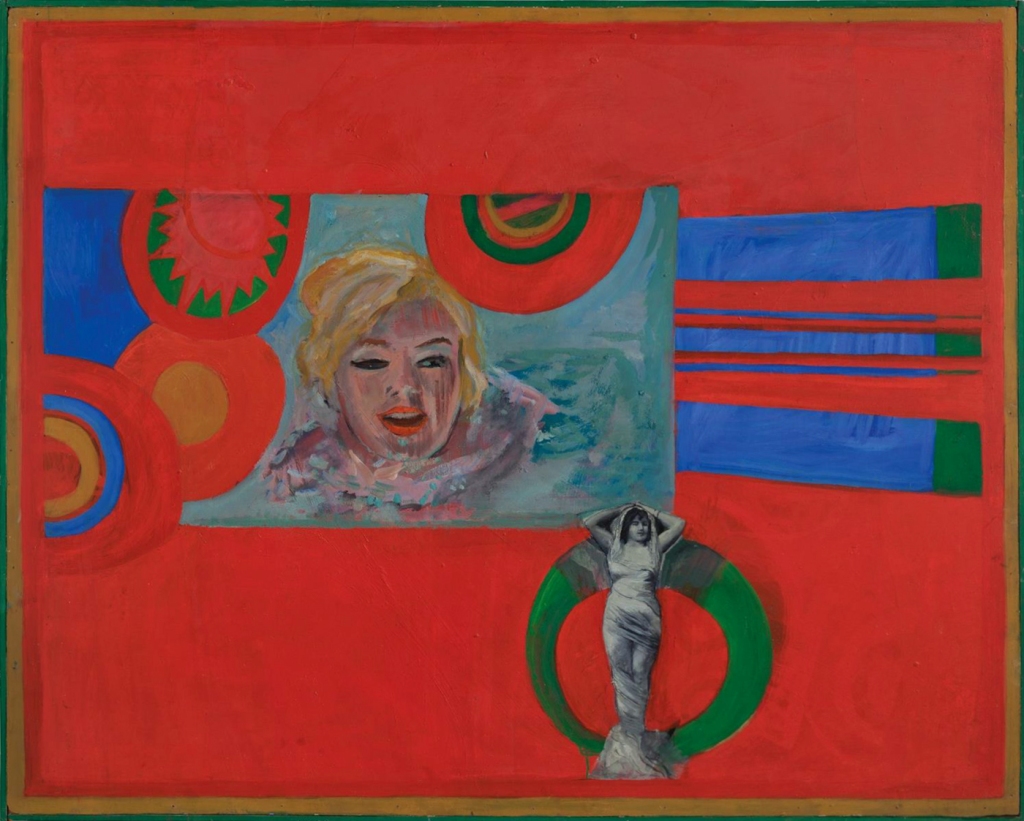
Pauline Boty (1938-1966), 1962, Epitaph to Something’s Gotta Give, oil on board (estimate: £500,000-800,000). Image courtesy of Christies
Christie’s London has announced the following exciting news:
“THE ONLY PORTRAIT OF MARILYN MONROE BY BOTY IN PRIVATE HANDS, we will offer Pauline Boty’s celebratory tribute to Marilyn Monroe, Epitaph to Something’s Gotta Give (1962, estimate: £500,000-800,000), as a leading highlight of the Modern British and Irish Art Evening Sale on 20 March. The painting was gifted to a close friend of Boty’s in 1964 and has remained in the same collection since. One of Pop Art’s founding members, Pauline Boty died prematurely at the age of 28 in 1966. Epitaph to Something’s Gotta Give is one of only around 25 Pop paintings that Boty created and was included in a rare lifetime exhibition at Arthur Jeffress Gallery in London in 1962.
Boty painted two further depictions of Monroe as tributes to the actress following her death, both of which are held in museum collections: Colour Her Gone, 1962 (Wolverhampton Art Gallery) and The Only Blond in the World, 1963 (Tate, London). Epitaph to Something’s Gotta Give will be on view in New York from 9 to 21 February before being exhibited in London from 13 to 20 March.
Angus Granlund, Head of Modern British and Irish Art Evening Sale, Christie’s: ‘Painted in Boty’s distinctive style, Epitaph to Something’s Gotta Give takes the form of a pictorial collage that is entirely rendered in oil paint. A celebration of female empowerment, this is thought to be Boty’s only painting of Monroe painted during the actress’ lifetime. The epitaph referred to in the title relates to the film Something’s Gotta Give shutting down production. The centrepiece of the composition is taken from a photograph published in Life magazine on 22 June 1962, depicting Monroe swimming in a pool on set. Collecting, collating and synthesising mass culture imagery from newspapers, adverts and magazines was central to Boty’s practice. A true polymath, as well as being a ground-breaking artist, Boty was also a talented actress and political activist. She strongly identified with Monroe and is often associated with her. Held in the same private collection since 1964, this rare painting brings together these two celebrated 1960s icons. Christie’s is honoured to present Epitaph to Something’s Gotta Give as a leading highlight of the Modern British and Irish Art Evening Sale and look forward to welcoming clients in New York and London to view this Pop Art masterpiece.’
Pauline Boty was a pioneering artist whose work shaped one of the greatest movements in British art of the 20th century. Within her short lifetime, she created a powerful, vibrant group of works that explored popular culture and left-wing politics, subjects which were coming into sharp focus in the 1960s. Boty studied at the Royal College of Art, the seedbed of the Pop Art movement, where she met, befriended and went on to exhibit with Sir Peter Blake, Derek Boshier, David Hockney, Peter Phillips and Patrick Caulfield. In 1961, she exhibited along with Blake, Geoffrey Reeve and Christine Porter at the A.I.A. Gallery in a group show seen as the very first Pop Art exhibition.”
Lot detail Epitaph to Something’s Gotta Give, 1962 Oil on hardboard 106.5 x 127 cm
Estimate GBP 500,000-800,000
Auction details Modern British and Irish Art Evening Sale 20 March 6:30PM GMT | Live Auction 22673
Viewing New York: from 9–21 February London: from 13–20 March
Further information will both be added to this post and be available here nearer the time: [link]
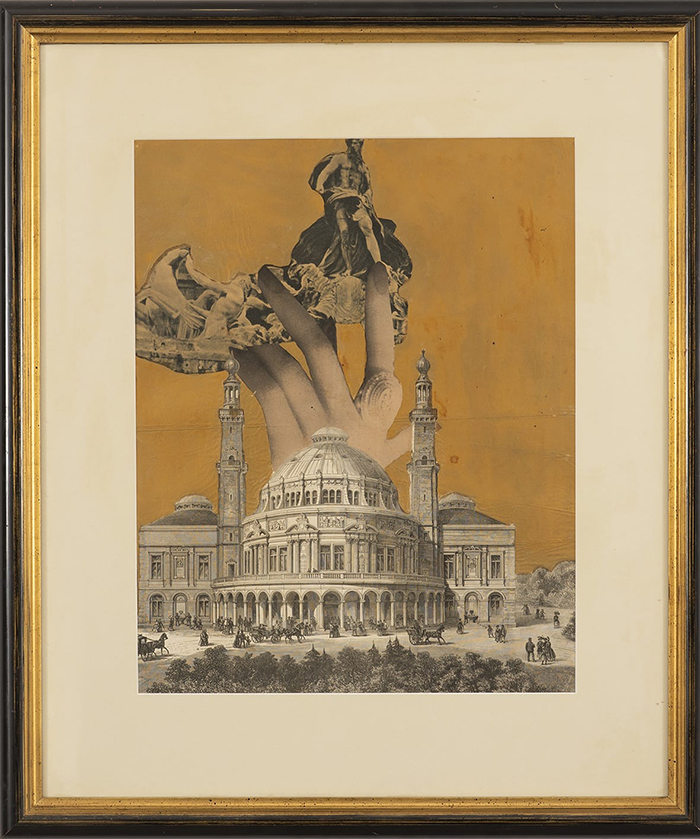
Pauline Boty, A Big Hand, collage with gold gilt paint, 1961
Running from 21 January to 12 March 2022, the exhibition is dedicated to the 60s wave of female emancipation in the UK and US and features Pauline Boty together with Judy Chicago, Penny Slinger and Jann Haworth.
“Showing for the second time at the gallery, Pauline Boty (1938–1966) was a founder of the British pop art and Britain’s most notable pop art painter. Her paintings and collage work often made references to female sexuality as well as current affairs, criticising the nature of the “man’s world.” On display in the exhibition is Angel (60s) and A Big Hand (ca. 1961), a collage work depicting a female hand holding sculptural figures from Rome’s Trevi Fountain above a Victorian park scene.
Gallery artist Jann Haworth (b. 1942) moved to London from Los Angeles in 1961 to study at the Slade School of Fine Art, becoming a pioneer of soft sculptures that led her to challenge the notion of female form serving as a muse or object of desire. Exhibited works include the Pom Pom Girl (1964-65), China Cabinet (1963–1964), Dog (1962), Linder Doll (1965), Still Life Marble Fabric ( 1962) and Rhinestones (1963–64).
Penny Slinger (b. 1947) explores feminism and eroticism through work including photography, film and sculpture. On display are a series of vintage black and white photographs from the artist’s subversive Bride Book (1973) and works from her 1973 series Mouthpieces.
Multidisciplinary artist Judy Chicago was a trailblazing pioneer the feminist movement in the 1960s and ’70s; for decades, she has made work that celebrates the multiplicity of female identity. The exhibition features And She Vomited up the Sun and the Moon and then the night had its Own Light (1981) and her pyrotechnic Atmospheres series.
The exhibition title draws on the 60th death anniversary of Marilyn Monroe, whose death represented a departure point for female empowerment. A portion of proceeds will be donated to Women’s Aid.” [from the Gazelli Art House website]
Gazell Art House, 39 Dover Street, London W1S 4NN Tel: +44 207 491 8816 Link to exhibition website: [link]
“London’s New Scene: Art and Culture in the 1960s” review, Dance Gazette, June 2020
Two works by Pauline Boty have been chosen for June’s Dance Gazette – the magazine for the Royal Academy of Dance – to illustrate their book review of London’s New Scene: Art and Culture in the 1960s [see previous post]. The review notes “Dance is also in the mix – from the filmmaker Ken Russell, besotted with classic Hollywood musicals, to the artist Pauline Boty, who was a regular dancer on the tv pop series Ready Steady Go! and a dab hand at the twist. ‘All over the country young girls are sprouting, shouting and shaking,’ she said, ‘and if they terrify you they meant to.’” More info on the magazine is here [link]





 Pauline Boty