Boty’s rarely-seen “Red Manoeuvre” included in Gazelli’s new exhibition for Derek Boshier

Pauline Boty, “Red Manoeuvre”, 1962, oil on board. Image courtesy of Gazelli Art House

The Way Forward: Derek Boshier and the Sixties will run from 25 April – 6 June at Gazelli Art House, with works by Peter Blake, Derek Boshier, Pauline Boty, Patrick Caulfield, David Hockney, Allen Jones, R.B. Kitaj, Peter Phillips, Richard Smith and Joe Tilson.

“Gazelli Art House London is pleased to present The Way Forward: Derek Boshier and the Sixties, the first posthumous solo exhibition dedicated to Derek Boshier (1937—2024). Curated with renowned art historian Marco Livingstone, the exhibition focuses on works from the 1960s and charts the transformations in Boshier’s worldview and visual style, in parallel to wider changes in society. This landmark presentation revisits Boshier’s pivotal transition from pioneering Pop figuration to bold geometric abstraction, a shift catalysed by his travels to India in 1962 under a Commonwealth scholarship.

Together with fellow RCA students David Hockney, Allen Jones, Peter Phillips and R. B. Kitaj, he participated in the landmark Young Contemporaries exhibition at R.B.A. Galleries London in 1962, which propelled Pop Art to public prominence. Among the first exponents of British Pop Art, Boshier distinguished himself from contemporaries such as Peter Blake and Pauline Boty through his unique brand of satirical social commentary. Two important paintings from this formative student period of Boshier’s work, Special K (1961) and W for Euthanasia (1962), represent twin poles of this art, though both combine narrative elements, references to moral dilemmas and to the human predicament as reflected in the news, advertising, consumerism and popular culture. Special K, one of Boshier’s key Pop works, takes its striking central motif from a popular American breakfast cereal manufactured by the multinational company Kellogg’s and combines it with a prescient reference to James Bond predating the first Bond film by a year – and the Thunderball movie by four years – and to the American-Russian space race in the rockets firing upwards into the letter ‘K’. Euthanasia, painted within living memory of the Nazi death camps active during the artist’s own early childhood, presents a sequence of generic figures alongside portraits of men protecting themselves with gas masks, as a caustic perspective on a subject that remains just as contentious today in the discussions now taking place about assisted dying.

As early as 1963 Boshier had developed a distinctive approach to abstraction, embracing shaped canvases and vibrant geometric compositions. Moving away from his earlier more figurative Pop works, Boshier began employing dynamic colour contrasts and layered forms to create spatial ambiguity and a sense of movement. Although aligned with the aesthetics of post-painterly abstraction in the US by artists such as Kenneth Noland and Ellsworth Kelly, Boshier’s pieces are infused with his experiences when travelling in India, alongside the British Pop iconography he was so instrumental in shaping.

Boshier’s journey to India was transformative — his immersion in Hindu mythology and street iconography informed a strikingly new visual language. He encountered imagery woven into everyday life, from temple icons to barbershop posters, shaping a body of work that blended Pop sensibilities with symbolic motifs. His return to the UK marked a decisive shift: his compositions became bolder, more architectural and attuned to the mechanics of visual perception.
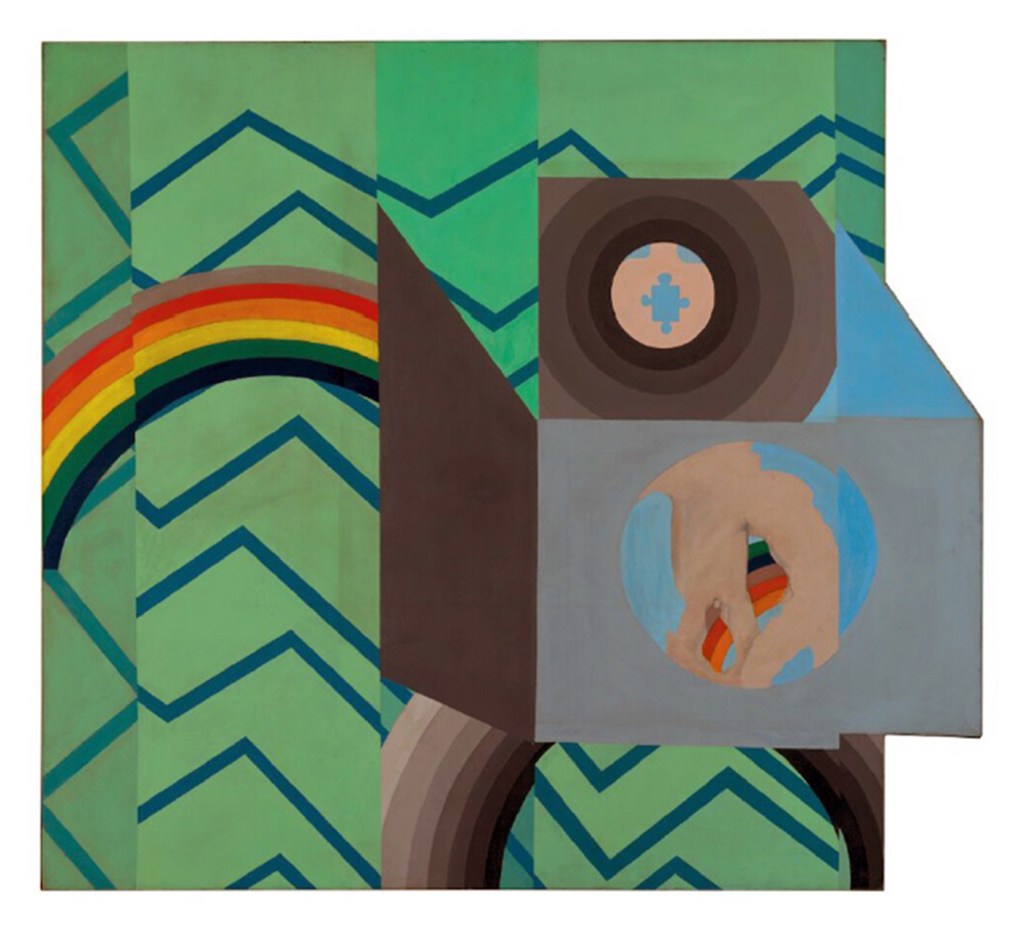
Derek Boshier, “Viewer”, 1965, Image courtesy of Gazelli Art House

The painting Viewer (1963) is a pivotal work in Boshier’s formal evolution. It contains figures depicted through viewfinder or window-like shapes and rainbow motifs, but departs from a rectangular canvas format through the asymmetric shaped support, reinforcing the illusion of depth in the composition. This work speaks to Boshier’s enduring fascination with how media, advertising and urban space influence perception.

Paintings from this period were showcased in the seminal New Generation exhibition at Whitechapel Art Gallery (1964) and at Robert Fraser Gallery (1965). They interrogate perception and representation through complex spatial arrangements and optical interplay. This experimentation led to bold, structured abstractions that shared affinities with the architectural rhythms of urban space. Shaped canvases such as Highlights (1966), with its dramatic array of inverted triangles, explore the illusion of depth through geometric fragmentation.

Reflecting on his own practice, Boshier once remarked: ‘I like to think of them as Pop abstraction. I looked at neon signs and that’s where it came out. India changed my life. I became a much more tolerant person. And I became a fatalist. Fatalists are optimists.’

The latter half of the 1960s saw Boshier increasingly engage with conceptual and political currents in art. Questioning the function of painting in an era of mass-media saturation, he expanded his practice to incorporate ready-made materials, film and text-based works, aligning himself with socially engaged artmaking. His active participation in political movements — campaigning against the Vietnam War, nuclear armament and systemic racism — underscored his commitment to art as a tool for cultural critique.
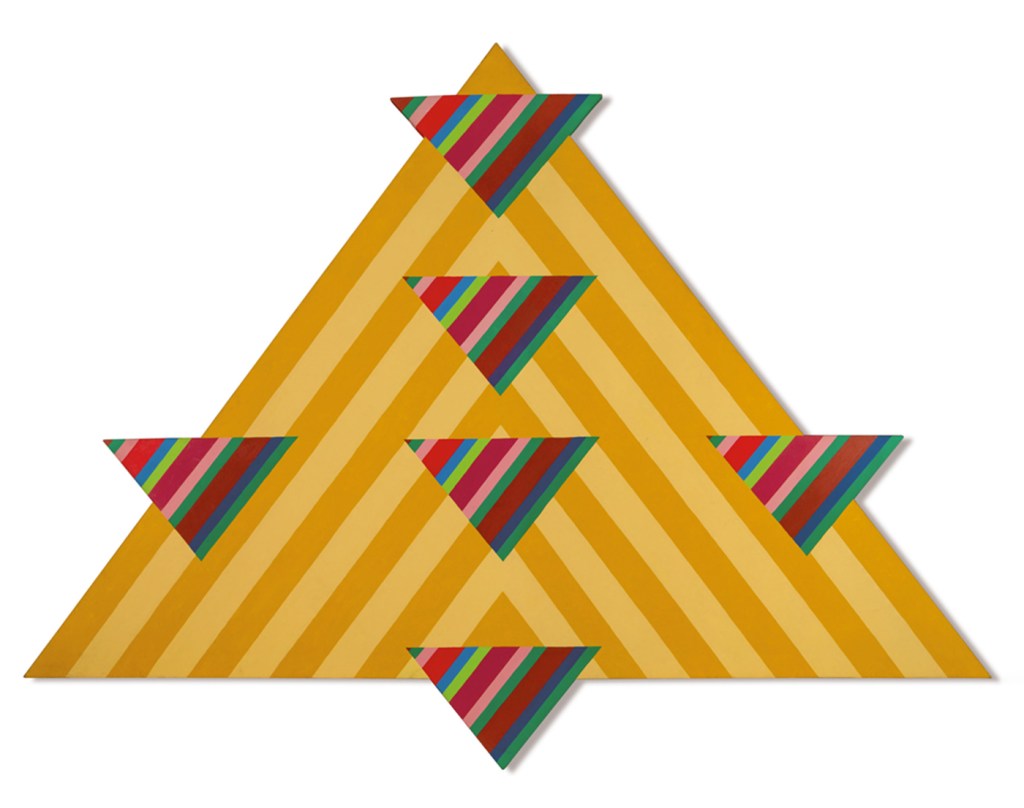
Derek Boshier, “Highlights”, 1966. Image courtesy of Gazelli Art House

Gazelli artist and contemporary of Boshier, Jann Haworth, describes these paintings as ‘a conversation stopper… no pigeonholing into Op or Pop; the painting is silent vision. A space at the heart of art town, a time and place to indulge in just looking, taking a long moment.’ They embody Boshier’s ability to balance precision with raw energy, a visual dynamism that continues to resonate today.

Complementing the presentation of Boshier’s paintings from the 1960s in the gallery’s main space will be a selection of works by artists who were also part of the contingent at the Royal College of Art associated with the rise of Pop Art in Britain: from the 1959 intake with Boshier are R. B. Kitaj, David Hockney, Allen Jones and Peter Phillips; Pauline Boty, who began her studies a year earlier in the Stained Glass department and became a fast friend; Patrick Caulfield, who arrived at the College a year after Boshier; and three artists, Peter Blake, Joe Tilson and Richard Smith, who had completed their studies at the College in the mid-1950s but who became friends, mentors, and sources of inspiration to the younger artists including Boshier himself. Ken Russell’s celebrated BBC film Pop Goes the Easel, which introduced Pop Art to the general public, featured Boshier alongside Blake, Boty, and Phillips.

The exhibition also features key works by these artists, each shaping the trajectory of British Pop Art. David Hockney’s 3 Snakes (1962) subverts abstraction with coded homoerotic imagery, blending illusionism and flatness in a playful challenge to formalist painting. Pauline Boty’s Red Manoeuvre (1962) captures the energy of the Swinging Sixties, using bold colours and a red-uniformed figure to explore female sexuality and cultural iconography. Peter Blake’s Sammy Davis Jnr (1957—1960) reflects his fascination with celebrity culture, while Joe Tilson’s Page 16: Ecology, Air, Earth, Fire, Water (1969) merges screenprint and wood relief to address countercultural politics and his exploration of the Four Elements. Peter Phillips’s One Five Times/ Sharpshooter (1960) embodies the graphic dynamism of Pop, and Patrick Caulfield’s Pony (1964) marks his shift toward a refined, hard-edged style. Allen Jones’ Cockpit (1963) extends his fascination with the canvas as object previously seen in his bus paintings of 1962 and with the fusion of figuration with languages of abstraction. Richard Smith’s A Whole Year a Half a Day VIII (1966), one of a series of twelve three-dimensional paintings referencing the calendar months and the hours on a clock, provides abstract equivalents for the prosaic objects they reference, taking Pop concerns into more minimalist territory. Together, these works highlight the breadth of Pop Art’s experimentation, from figuration to abstraction, capturing a movement deeply attuned to the cultural pulse of its time.

Boshier’s 1960s abstractions cement his position within a transatlantic dialogue of formal experimentation while remaining deeply personal in their conceptual rigour. His ability to synthesise the energy of advertising culture with the concerns of abstraction speaks to his enduring relevance. The Way Forward: Derek Boshier and the Sixties offers a vital reconsideration of his artistic legacy.”


Further information

Gazell Art House,
39 Dover Street,
London W1S 4NN
Tel: +44 207 491 8816
Gallery website: [link]
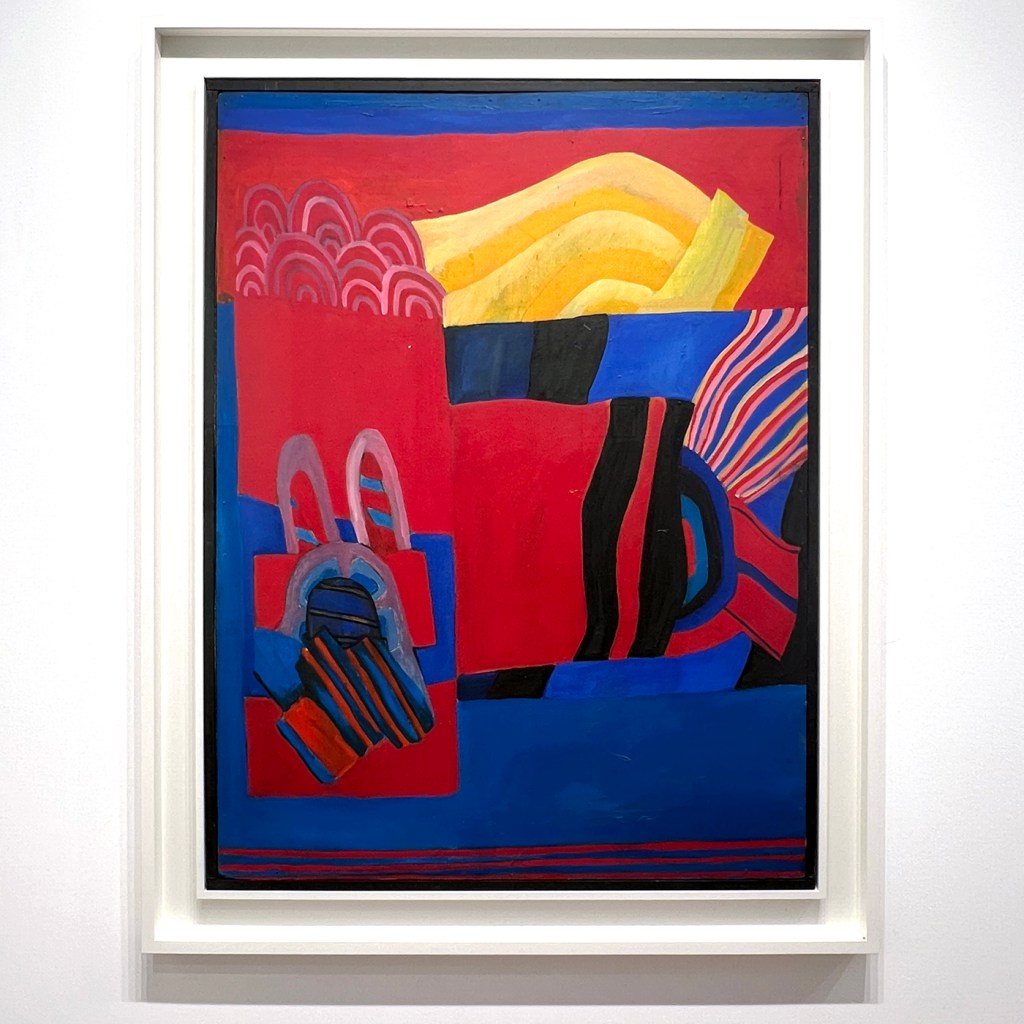
Gazelli Art House to include Pauline Boty works at Dallas Art Fair 2025

Pauline Boty, “Untitled (red yellow blue abstract”), 1961, Oil on board. Photo by paulineboty.org

Dallas Art Fair 2025 will run from 10 – 13 April at the Fashion Industry Gallery in the Dallas Arts District. Gazelli Art House (Booth A5) have announced the following about their attendance:

”Derek Boshier, Pauline Boty, Harold Cohen and Jann Haworth: Gazelli Art House is delighted to announce its debut at the Dallas Art Fair 2025, presenting a selection of works by pioneering artists Derek Boshier (1937—2024), Pauline Boty (1938—1966), Harold Cohen (1928—2016) and Jann Haworth (b. 1942). The artworks brought together highlight the importance of Dallas and Texas in the careers of major British Post-War artists—with some of them having lived there, while others were exhibited and collected by major Texan institutions.

Central to the selection will be Post-War AI pioneer Harold Cohen’s rarely exhibited large-scale figurative paintings, presented alongside early AARON drawings and a work from his Painting Machine series. These works offer a unique perspective on Cohen’s groundbreaking fusion of art and code, tracing his transition from traditional painting to computational creativity. Developed in the 1970s at Stanford’s Artificial Intelligence Laboratory, AARON is one of the earliest AI programs for autonomous art-making, capable of making intricate compositions without direct human intervention. Cohen’s research into machine-generated imagery established him as a foundational figure in generative art, influencing subsequent waves of artists working at the intersection of technology and aesthetics. His legacy continues to shape contemporary digital art, with recent institutional recognition including exhibitions at LACMA, the Whitney Museum, and Tate Modern’s Electric Dreams: Art and Technology Before the Internet (On view until June 2025).

An intimate selection of works by Derek Boshier also features. Taken from his Texas series, painted during his years living in Houston in the 1980s and early 1990s, these include pieces such as Fashion Victim in the Snow (1987) and Sea Visitor (Boat) (1987) which reflect Boshier’s engagement with pop culture iconography, filtered through his sharp wit and European perspective. The thick impasto and exaggerated gestures create a sense of both physical and conceptual tension, and are indicative of Boshier’s critical yet playful commentary on identity, spectacle, and cultural mythmaking.

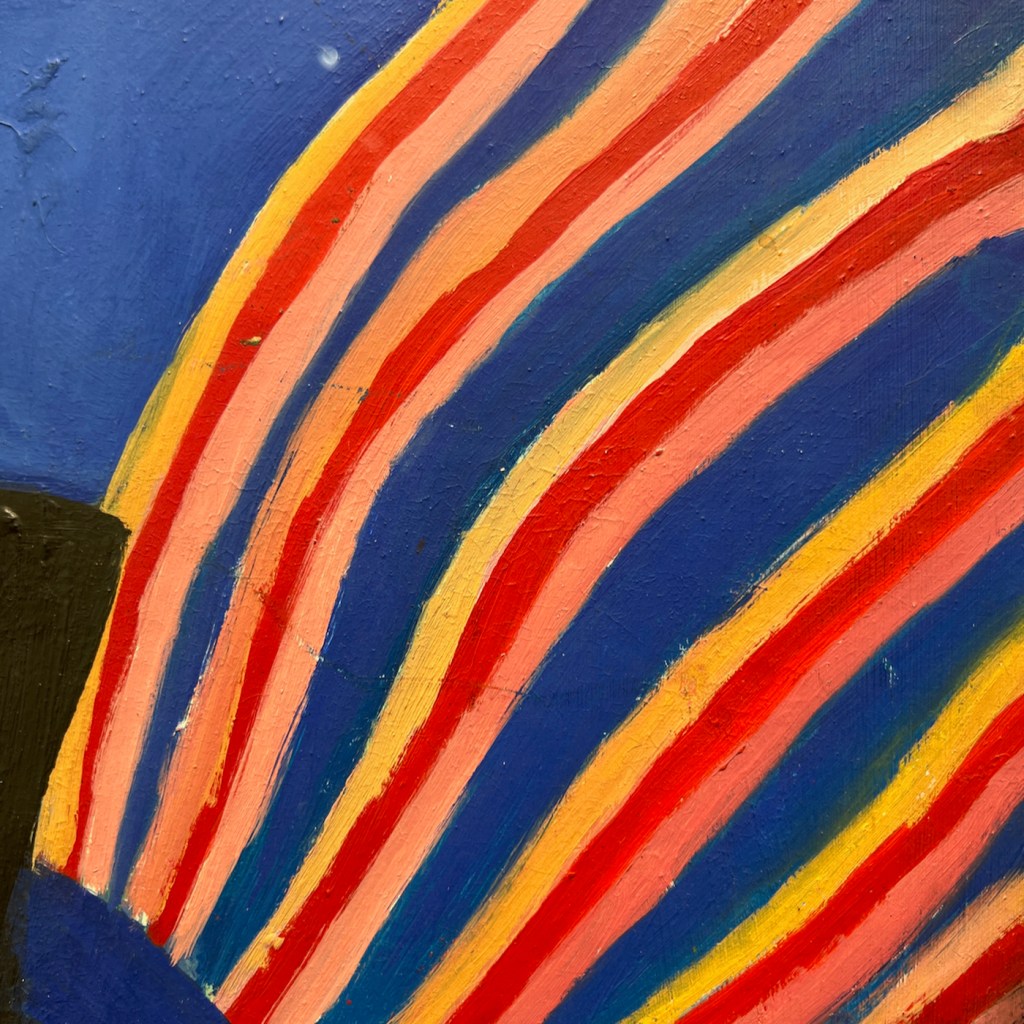
Pauline Boty, “Untitled (red yellow blue abstract”), [detail], 1961, Oil on board. Photo by paulineboty.org

Pauline Boty’s Untitled (Red Yellow Blue Abstract) (1961) is one of only four abstract paintings the charismatic artist made in a career that was tragically cut short at the age of 28. Executed just after her graduation from the Royal College of Art, the work captures the dynamism of the Swinging Sixties through its bold colour interplay and shows a dialogue with the work of friends and peers such as David Hockney and Derek Boshier. Complementing this is Boty’s rarely exhibited portrait of mafia boss Big Jim Colosimo (c.1963), rendered in her signature photorealistic black-and-white style and framed within a playful fairground-inspired border. The resurgence of interest in Pauline Boty’s work is evident in exhibitions such as Pauline Boty, A Portrait at Gazelli Art House (2023/4), Capturing the Moment at Tate Modern (2023), and the landmark solo show Pauline Boty: Pop Artist and Woman at Wolverhampton Art Gallery (2013), reaffirming her significance within the Pop Art movement and beyond.

Pauline Boty, “Big Jim Colosimo”, Oil on canvas, 1963

The booth will also showcase several key works by Pop Art icon Jann Haworth, including the delicate work on paper The Bead (1964), a study for her celebrated Beads and Background (1963—64) sculpture, which is in the collection of Tate. Alongside this will sit an early ‘soft sculpture’ piece titled Dog (1962), first exhibited at the Institute of Contemporary Art in London in 1963. Haworth’s works during this period recontextualised craft as a means of challenging the masculine aesthetics of the Pop Art movement. Throughout the 1960s, she developed a series of cloth-based works which disrupted and complicated depictions of the female form in much of the art of the time, positioning her among the leading figures of British Pop alongside Richard Hamilton and her then-husband, Peter Blake. Haworth’s impact on contemporary art continues to be recognised globally, with several major institutional exhibitions currently on view. Pop Forever at the Fondation Louis Vuitton in Paris, Counterpoint at the BYU Museum of Art in Utah, Pattern: Rhythm and Repetition at Pallant House Gallery in the UK, Iconic: Portraiture from Francis Bacon to Andy Warhol at the Holburne Museum, UK, and Mapping the 60s at mumok, Austria all prominently feature her work. Earlier this year she presented her Work in Progress mural—co-created with collage artist Liberty Blake—as part of the Arts and Culture Programme at the World Economic Forum in Davos, reinforcing her ongoing engagement with themes of representation and social history.

Marking an exciting milestone for Gazelli Art House, this inaugural participation at Dallas Art Fair underscores the gallery’s commitment to championing artists who have challenged artistic boundaries and shaped contemporary discourse from the 1960s to the present day.”
.
Further information

DALLAS ART FAIR
October 9 – 13 2024
Fashion Industry Gallery,
1807 Ross Avenue,
Dallas, Texas 75201
Dallas Art Fair website: [link]
Tickets are available to buy here: [link]

Gazell Art House,
39 Dover Street,
London W1S 4NN
Tel: +44 207 491 8816
Gallery website: [link]
Definitive history of “Ready, Steady, Go!” is out now

“Ready, Steady, Go! The Weekend Starts Here” by Andy Neill. Published by BMG Books.

“Ready, Steady, Go! The Weekend Starts Here” by Andy Neill has just been published by BMG Books. The 12″ x 12″ hardback comprises 272 pages with a UK retail price of £39.99.

Pauline Boty danced on the first show and was from then on a regular dancer with Derek Boshier. Both are mentioned in the book and Boshier’s 10th July 1964 dancer’s badge button is included among its illustrations.

From the BMG press release:

“Almost sixty years have passed since the first transmission of the most influential popular music programme in British television history.
Ready, Steady, Go! began broadcasting on Friday, 9th August 1963 and became an essential television ritual for the newly confident British teenager. It provided a style bible – setting trends and becoming the barometer for popular culture.
It epitomised the spirit of youthful optimism that gripped Britain in the mid- Sixties, reflected by the handpicked Mod audience who were an integral part of the programme. This was perfectly embodied by girl-next-door presenter Cathy McGowan whose shy, almost awkward demeanour directly connected her with the show’s target audience.
It ran for three and a half years up to December 1966, its demise coinciding with the loss of pop’s innocence and the birth of the ‘rock industry.’ Within that time RSG! set a blueprint for music presentation and production on British television that resonated over the following decades and can still be felt today.
It attracted and presented anyone who was anyone in popular music at the time: The Beatles, The Rolling Stones, The Who, Marvin Gaye, The Supremes and Otis Redding were just some of the important names that appeared. RSG! not only gave invaluable television promotion to these greats but also provided such then-unknowns as Rod Stewart, Marc Bolan, David Bowie, Donovan, and Jimi Hendrix with their first small screen exposure.
Ready, Steady, Go! broke through technical barriers. Young adventurous directors such as Michael Lindsay-Hogg experimented with camera techniques used in French nouvelle vague cinema. The sets that were designed each week by Nicholas Ferguson were consciously modelled on current mod fashions and op art (Hockney, Riley, Blake etc.)
Ready, Steady, Go! has never been documented in full detail before – until now. Thanks to exclusive contributions and unseen photographs and memorabilia, author Andy Neill fully examines Ready, Steady, Go! from quintessential Swinging London accessory to its current iconic status as the most legendary popular music programme of all time.”

Two documentaries on “Ready Steady Go!” to be screened on BBC4 this evening

The programme was clearly close to Pauline Boty’s heart – she was regularly chosen as a dancer in the audience with her friend and fellow Pop artist Derek Boshier. The first documentary includes footage of them dancing in the party scene concluding Ken Russell’s “Pop Goes The Easel”.
Further information from and links to the BBC website below:

“The story of Britain’s iconic 1960s music show, Ready Steady Go! The programme revolutionised television ‘for the kids’ and coincided with the tremendous explosion of British pop talent that took the world by storm. It championed emerging talent like The Beatles, The Who, Sandie Shaw, Cilla Black, Otis Redding and The Rolling Stones.”

The Story of Ready Steady Go!
BBC4, 21:00, Friday 20th March 2020
We go behind the scenes and speak to the people who made it all happen, including original producer Vicki Wickham and the programme’s pioneering director, Michael Lindsay-Hogg. Plus further contributions from Annie Nightingale, Eric Burdon, Chris Farlowe, Mary Wilson, Martha Reeves, Paul Jones, Gerry Marsden and Jools Holland.
Further information available here [link]

The Best of Ready Steady Go!
BBC4, 22:00, Friday 20th March 2020
This priceless archive has rarely been seen and includes some of the most memorable performances from the greatest stars of the day. Tune in to see The Beatles perform Twist and Shout on a moving stage, The Rolling Stones presenting their very own episode, and Otis Redding’s sensational duet with Chris Farlowe and Eric Burdon. Other acts include Cilla Black, Lulu, and Martha and the Vandellas. Dusty Springfield also takes centre stage.
Further information available here [link]

New interview with Derek Boshier at paulineboty.org – extracts below:

Paulineboty.org: What were your first impressions when you met Pauline Boty?
Derek Boshier: My first impressions on meeting Pauline were the same as almost everybody. She was a very vivacious, glamorous intellectual. You know. And a lot of fun –the fact that she should have died so early aged 28… I mean, she loved life, you know – and she knew how to live it. She was just good to be around really. And that aspect of her, knowing how to live life, really fed her paintings too.

PBO: Did Pauline express her frustration at having to study stained glass instead of art as she’d originally wanted to?
DB: No. Mainly because she wasn’t a complainer. Politics though – Yes – but not her personal life. The Anti-Ugly March she organised for example, which I went on. She was the figurehead for that. The point about her is that she said her mind – not only in paintings with sensuality and sexuality, but she said it with architecture. I mean she was very direct.

PBO: And your painting “Pauline Boty Goes Digital [for Pauline Boty]”. How did that come about?
DB: Well it’s a very large painting that I made in 2011. You know, I always think of Pauline and what she did and I’m often reminded of her when people write to me and ask me about her or “Pop Goes the Easel” and I remember my friendship with her. I was about to start a new series of paintings about smartphones and I just thought before I do that I’d like to do a homage to Pauline as it were, just to help keep her in people’s memory really.

Full interview here: [link]