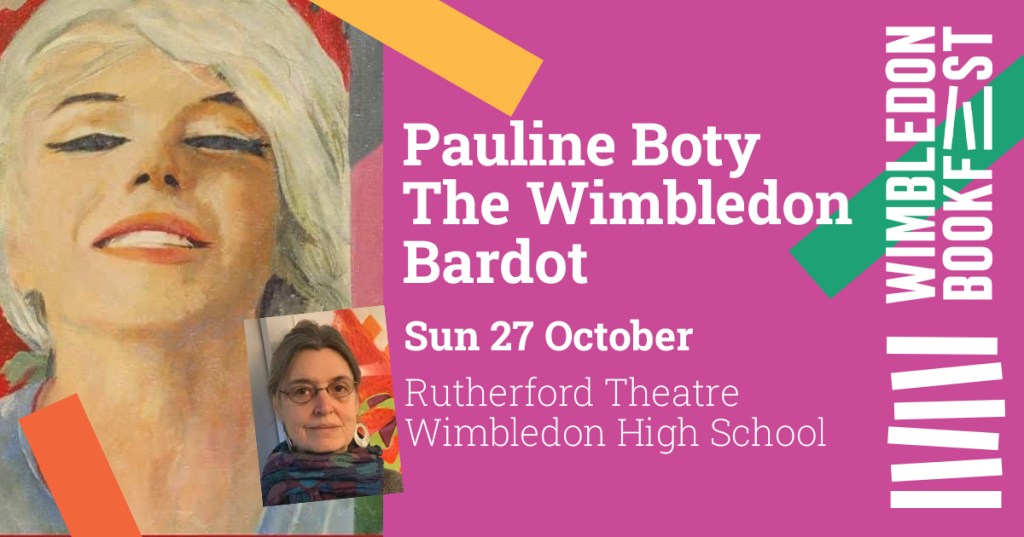
As part of their annual festival Wimbledon Bookfest have announced the a talk between Dr Sue Tate and Samira Ahmed at Rutherford Theatre, Wimbledon High School on Sunday 27 October at 3:00pm:
“An opportunity to find out more about one of the leading co-founders of the British Pop art movement, Pauline Boty.
Known as the Wimbledon Bardot, Pauline Boty was a student at Wimbledon School of Art. She smashed stereotypes and confronted issues well ahead of her time, but was not given the recognition she deserved. During her tragically short life, she produced an exciting and complex body of work, commenting on pop culture, feminism and so much of the era in which she lived. Dr Sue will be in conversation with BBC broadcaster and journalist Samira Ahmed.”
‘The life of Boty? A Molotov fusion of possibility and loss.’ – Ali Smith”
Details Title: Pauline Boty: The Wimbledon Bardot Location: Rutherford Theatre at Wimbledon High School Date: Sunday 27 October 2024 Time: 3:00 pm Tickets are £15 and can be booked here [link]
A Year in the Life of the Swinging Sixties was broadcast yesterday on Radio 4 and is now available at BBC Sounds. . It features clips of Pauline Boty alongside other contributors including Mary Quant and The Beatles from “The Public Ear”, a fortnightly programme on culture and entertainment she co-presented, including her thoughts on the popularity of romantic fiction! The programme ran from 6 October 1963–22 March 1964. . “James Peak and Joan Bakewell find some incredible hidden BBC archive from 1963. Wait! Is that The Beatles? And Mary Quant? And Morecambe & Wise?
The Public Ear was a bold new arts show, broadcast on The Light Programme in 1963, which tried to make sense of all the amazing things that were happening in London and the UK in music, art, theatre, comedy, football, politics and feminism. Travel back in time for a Year in the Life of the Swinging Sixties, for archive unheard for these last 60 years – the precise moment that Beatlemania started and the National Theatre was founded, a time when broadcasters could ask people on the street who they’d drop a bomb on. Joan Bakewell was there the first time around and puts these amazing archive finds into context.” [from the programme website] . The programme is available here: [link]
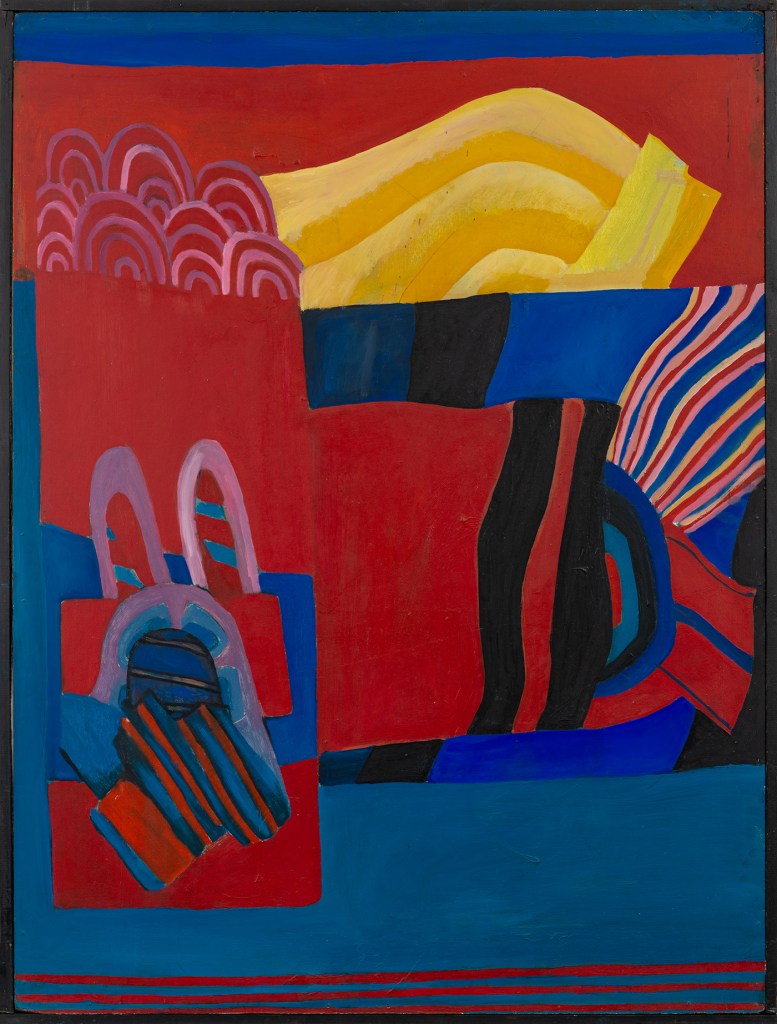
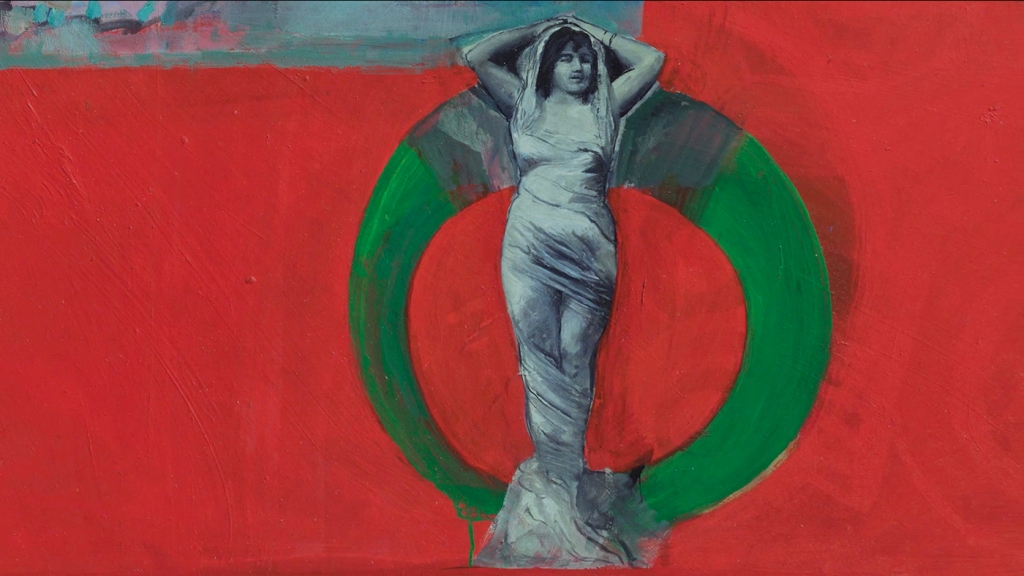
Pauline Boty, “Untitled (red yellow blue abstract”), 1961, Oil on board (PB052). Courtesy of Private Collection and Estate of Pauline Boty. Image courtesy of Gazelli Art House
The exhibition will run from Wednesday 9 – Sunday 13 October 2024 in The Regent’s Park with over 270 galleries from more than 40 countries present. Gazelli Art House have announced the following about their attendance:
”We are thrilled to present a solo booth at Frieze Masters 2024 dedicated to the pioneering British painter Pauline Boty (1938–1966). This exclusive exhibition offers an unparalleled opportunity to engage with significant paintings from across Boty’s short but incendiary career, accompanied by an insightful selection of archival material. This presentation, Gazelli Art House’s first booth for Frieze Masters, reaffirms the gallery’s commitment to celebrating Boty’s effervescent life and her lasting impact on the art world. It follows the success of Pauline Boty: A Portrait at Gazelli Art House, London (1 December 2023–24 February 2024) which was Boty’s first posthumous solo exhibition in a decade.
A pivotal figure in the British Pop Art movement of the 1960s, Boty defied conventional norms with her fearless exploration of femininity, politics, and popular culture. Often overshadowed by her male peers during her lifetime – a life tragically cut short by her untimely death from cancer in 1966 at the age of 28 – Boty’s work is now rightfully recognised for its significant contribution to the cultural discourse of her time, and its enduring influence on subsequent generations. In the words of art historian and leading Boty expert Dr Sue Tate ‘Her work was so bold, so outrageous, so unusual, and she so shattered gender expectations that people couldn’t cope.’
Key pieces on display include Untitled (red yellow blue abstract) (1961), unseen by the public for over two decades, is one of only four abstract paintings Boty made and encapsulates the spirit and vibrancy of the ‘swinging’ sixties. Boty insightfully described the pop art movement as a “nostalgia for now”, and regularly incorporated contemporary subjects in her work, including Elvis Presley and Marilyn Monroe, and an Italian Mafia boss in the painting Big Jim Colosimo (c.1963).
Boty’s astute social commentary was bound up with the active role she herself played the cultural milieu of the era. Her illustrious career encompassed stage, screen, and radio, with standout performances in the film Alfie (1966) and Frank Hilton’s Day of the Prince (1963). Archival photographs included in the Frieze Masters presentation vividly capture Boty’s dynamic persona.
This exhibition not only honours Boty’s pioneering approach and feminist legacy but also celebrates the concerted efforts of many to secure her rightful place in art history. Gazelli Art House is proud to lead this significant moment, recognising and celebrating Pauline Boty’s impact. Boty enriched Pop Art by bringing together celebration and critique in a way no one had done before.” . Further information Gazell Art House, 39 Dover Street, London W1S 4NN Tel: +44 207 491 8816 Gallery website: [link]
FRIEZE MASTERS October 9 – 13 2024 The Regent’s Park Frieze Masters website: [link] Tickets for Frieze Masters and Frieze London are available to buy here: [link]
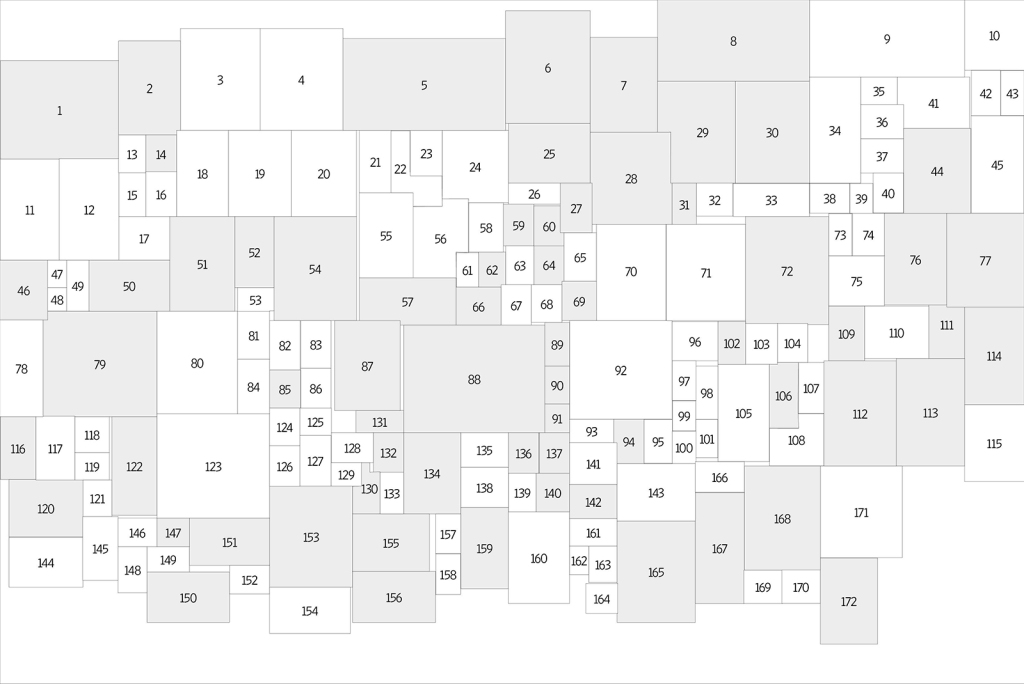
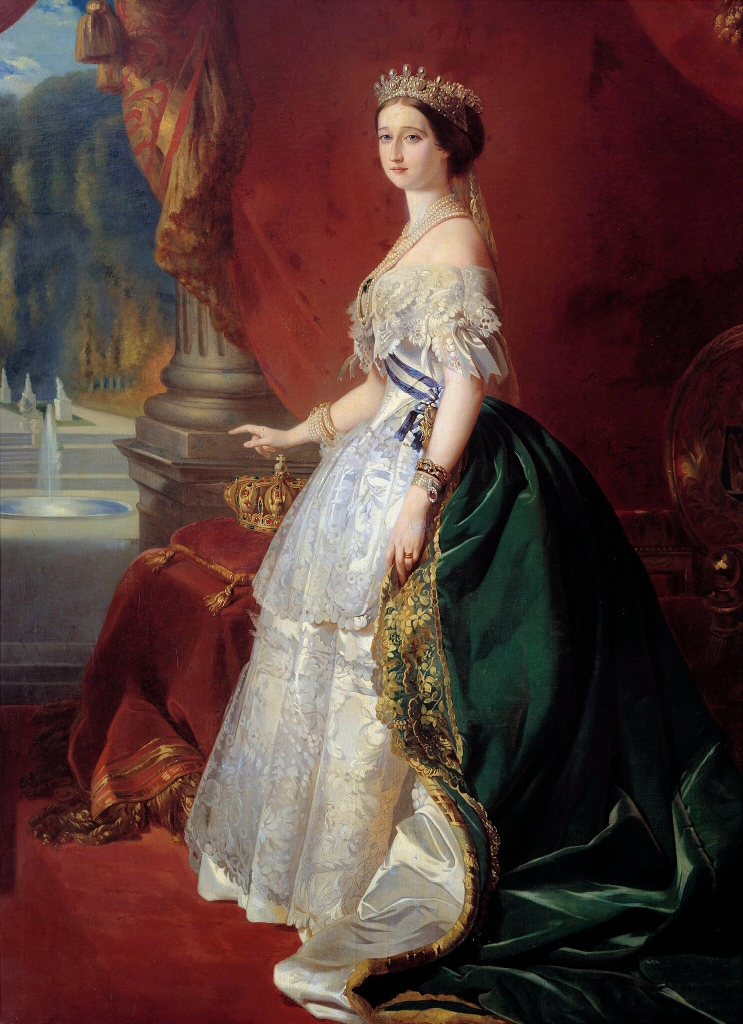
Three new items have been identified in the ongoing project to name those chosen by Pauline Boty for the collaged wall she assembled at her flat in west London photographed by, among others, Roger Mayne in 1964. Item #28 is of Queen Victoria and Empress Eugénie, c. 1855, #77 Emperor Napoleon III and Empress Eugénie, c. 1850s and #136 Portrait of Doge Leonardo Loredan, Giovanni Bellini, c. 1501–1502.
Pauline Boty: collaged wall key for 1964 Roger Mayne photo, V4, April 2024
The Wikipedia entry for Eugénie de Montijo notes: “The empress strongly advocated equality for women, pressured the Ministry of National Education to give the first baccalaureate diploma to a woman and tried unsuccessfully to induce the Académie Française to elect the writer George Sand as its first female member” and “She was perhaps the last Royal personage to have a direct and immediate influence on fashion. She set the standard for contemporary fashion at a time when the luxury industries of Paris were flourishing. Eugénie’s influence on contemporary taste extended into the decorative arts.” Further information is available here: [link]
With thanks to Jasmine Allen of The Stained Glass Museum for identifying the first two detailed above and Rachel Godfrey the third.
“Portrait of Empress Eugénie in Court Dress”, after Franz Xaver Winterhalter, 1855–1870, Collection Château de Compiègne. Public domain, via Wikimedia Commons
All comments, corrections, clarifications and suggestions from visitors to the site about this project would be greatly appreciated, via the Contact page here: [link] The updated page can be accessed here: [link]
Many thanks to Clive Goodwin’s nephew for sharing a number of press cuttings and photos recently, and for allowing a selection to be shown here on the website.
The first is of Pauline Boty and Clive Goodwin attending a family wedding in 1964 with the former presumably wearing the same Liberty cloche hat by her Royal College of Art friend James Wedge (as identified by Adam Smith) she wore when she and Goodwin were married at Chelsea Register Office on 24 June 1963, seen in a black and white news item from the time. The second photo is an undated publicity shot of Goodwin, presumably from the mid- to late-1950s. And the third is of a programme for a production of Antony Brown’s Paradise Street for the Studio Theatre Club on 20 January 1957 crediting Goodwin as Producer.
Pauline and Clive attending a family wedding in 1964. Photo courtesy of Clive Goodwin’s nephewc. 1950s publicity shot of Clive Goodwin by Landseer of Dean Street, London WC2. Photo courtesy of Clive Goodwin’s nephewProgramme for Antony Brown’s “Paradise Street”, 20 January 1957. Photo courtesy of Clive Goodwin’s nephew
Pauline Boty’s 1962 tribute to Marilyn Monroe, “Epitaph to Something’s Gotta Give”, sold earlier this evening at Christie’s London for £1,310,500 – a new record for one of her works! This was previously held by another of her paintings from 1962, “With Love to Jean-Paul Belmondo”, which sold for £1,159,500 at Sotheby’s in 2022. . The conclusion to the sale can be seen here: [link]
Pauline Boty (1938-1966), 1962, Epitaph to Something’s Gotta Give [detail], oil on board (estimate: £500,000-800,000). Christie’s Images Ltd. 2024.
Pauline Boty’s tribute to Marilyn Monroe, Epitaph to Something’s Gotta Give was exhibited at the Arthur Jeffress Gallery in August 1962, and gifted by the artist to a close friend two years later. It has remained in the same collection ever since.
Christie’s Modern British and Irish Art specialist Angus Granlund says the gift marked a key moment in Boty’s career: “A trailblazing pioneer and true polymath, Boty painted, acted, danced and engaged in political activism. However, at this key period she refocused her energy on painting, turning down acting roles to do so.” Granlund further describes the work as “a hugely important picture, and Boty’s only Marilyn painting still in a private collection. It unites two women who were synonymous with one another in the 1960s.”
Epitaph to Something’s Gotta Give (1962, estimate: £500,000-800,000), is a leading highlight of the Modern British and Irish Art Evening Sale on 20 March.
Ali Smith inspecting Epitaph to Something’s Gotta Give in the short film accompanying the lot essay. Christie’s Images Ltd. 2024.
The essay and short film with Ali Smith are available here: [link]
Lot detail Epitaph to Something’s Gotta Give, 1962 Oil on hardboard 106.5 x 127 cm
Estimate GBP 500,000-800,000
Auction details Modern British and Irish Art Evening Sale 20 March 6:30PM GMT | Live Auction 22673
Viewing New York: from 9–21 February London: from 13–20 March
Further information on the auction is here: [link]
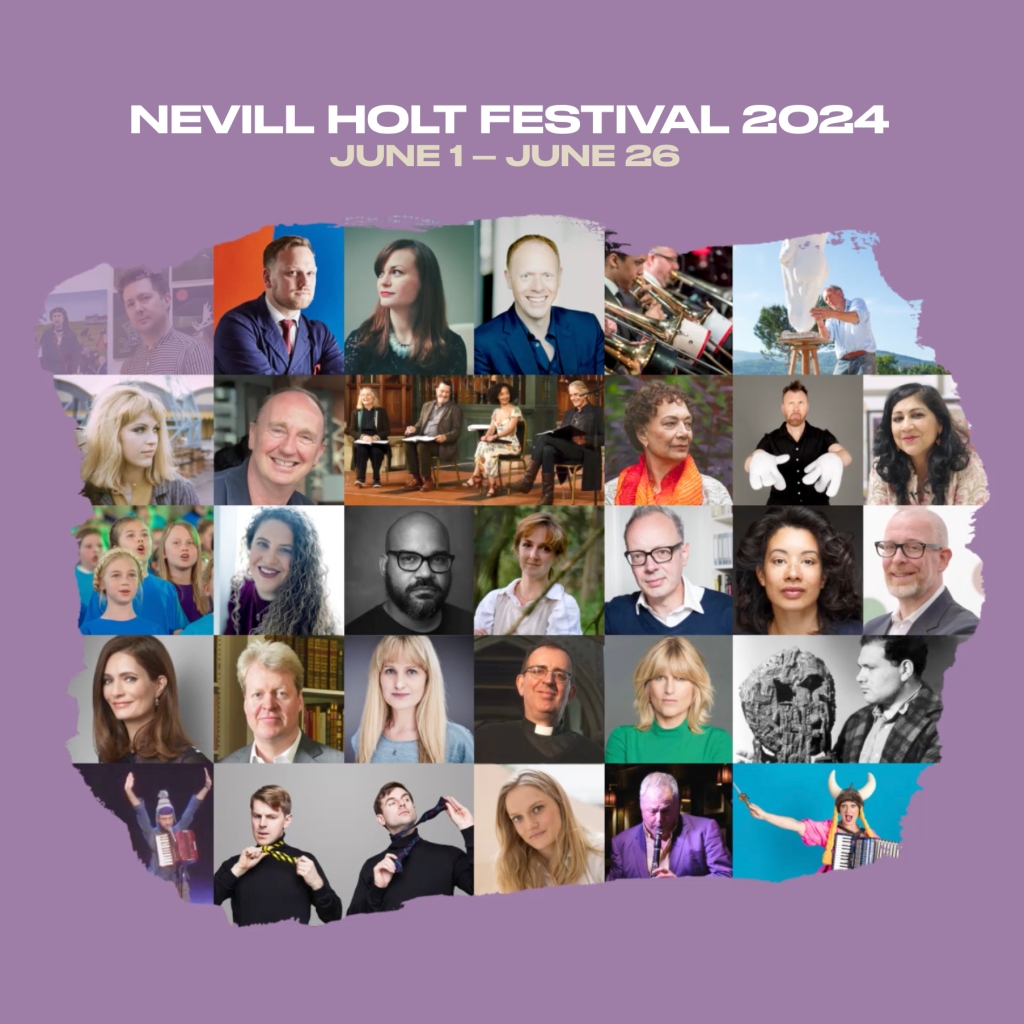
From the festival website: “Nevill Holt is proud to welcome a lineup of internationally renowned artists to Leicestershire this June for the inaugural Nevill Holt Festival. Building upon a decade of opera performances, the Festival will now also host classical music, theatre, art, jazz and contemporary music, alongside conversations with leading novelists, historians, broadcasters and artists.
Our afternoon celebration of British Pop art pioneer Pauline Boty (at 14:00 on Thursday 13 June in the Nevill Holt Theatre) begins with a world-exclusive showing of BOTY, the first-ever film to explore the fascinating life and times of the trail-blazing artist. This will be followed by a panel discussion featuring Dr Sue Tate, Natalie Gibson, Chila Kumari Singh Burman, Louisa Buck, Vinny Rawding and Lee Cogswell.
This documentary film celebrates the life of one of the most important British artists of the 20th century who within her art analysed, subverted and skewered Pop culture. The film documents the rise of Pauline Boty’s work, her artistic reputation and her legacy after many years of relative obscurity in the British art world following her early death in 1966.
Including newly discovered pieces and footage of Boty acting on screen, this film is the definitive portrait of one of Britain’s most vital and important artists.
Dr Sue Tate is an art historian, curator, author, and the leading expert on British Pop artist Pauline Boty. Author of the seminal book Pauline Boty: Pop Artist and Woman, Sue has curated several major retrospectives, and lectured on Boty around the world. Sue’s research has been instrumental in re-establishing Boty’s life and work, which was overlooked and forgotten over time. Through Sue’s work, Boty has rightfully been reinstated as one of the founders of British Pop art and one of the most enigmatic and important female artists of the 20th century.
Natalie Gibson is one of the most prolific and renowned contemporary textile designers, and was a close friend of Pauline Boty. Natalie trained at Chelsea School of Art and the Royal College of Art before teaching at Central St Martins where she has taught since 1962, founding and heading the BA Fashion Print course in 1981. Natalie has been instrumental in teaching and inspiring many of this country’s leading fashion designers, including Alexander McQueen, John Galliano, Matthew Williamson and Giles Deacon. She works closely with artists, such as Grayson Perry, and teaches design and print courses in India and China. Natalie was awarded an MBE in 2014 for her services to fashion. She also has her own clothing brand: Nat the Cat.
Chila Kumari Singh Burman is celebrated for her radical feminist practice which examines representation, gender and cultural identity. She works across a wide range of mediums including printmaking, drawing, painting, installation and film. In 2017, she was awarded an Honorary Doctorate and Honorary Fellowship from the University of Arts in London, and in 2021 received an honorary doctorate from UCL. In 2022 she was awarded an MBE for her services to the arts. Burman has exhibited widely with notable solo shows held at the Mansard Gallery, Heal’s London; Middlesbrough Institute of Modern Art; Output Gallery, Liverpool; Grundy Art Gallery, Blackpool and Tate Britain, London. Her works are also held in the public collections of The Arts Council Collection, The British Council, The Science Museum, The Tate Collection, The V&A and The Wellcome Trust.
Louisa Buck is a writer and broadcaster on contemporary art. She is a Contributing Editor and London Contemporary Art Correspondent for The Art Newspaper and a regular reviewer and commentator on BBC radio and TV. Her articles have appeared in publications ranging from The Guardian and Vogue to Frieze and Artforum. Her books include Moving Targets 2: A User’s Guide to British Art Now, Market Matters: The Dynamics of the Contemporary Art Market and Owning Art: The Contemporary Art Collector’s Handbook (co-authored with Judith Greer). Louisa was a judge for the 2005 Turner Prize and is a founding member of The Gallery Climate Coalition.
Filmmakers Vinny Rawding and Lee Cogswell are part of the creative team at Mono Media Films and Channel X, who have produced documentary films on Peter Blake, The Style Council, Tubby Hayes and many more over the last decade. Both are long-term admirers of Pauline Boty’s work and have spent the last five years piecing together the story of Boty’s life, bringing the first film on this Pop art pioneer to the big screen.”
Further information for the festival including how to book tickets is available here: [link]
Further information CELEBRATING PAULINE BOTY: BOTY FILM PREMIERE AND TALK Thursday 13 June 2024 14:00 Nevill Holt Theatre Market Harborough Leicestershire LE16 8EG
The new industry trailer for the forthcoming documentary film from Mono Media Films and Channel X, BOTY – The life and times of a forgotten artist (working title), was shown last night as part of the sold out Gazelli Talk: Pauline Boty From Canvas to Screen.
The evening included previews of documentaries showcasing Boty’s dynamic career in both art and acting alongside a panel talk with Cat Mayne (AD / Associate Producer), Lee Cogswell (Director), Libby Horner (Art Historian/Filmmaker), Marc Kristal (Author), Charles Mapleston (Filmmaker), and Vinny Rawding (Writer/Filmmaker) and was moderated by Travis Elborough (Author).
Mono Media / Chanel X, who have previously produced documentary films on Peter Blake, The Style Council, Tubby Hayes and more, have spent the last five years piecing together the story of Pauline Boty’s life and times to bring the first ever film on this Pop Art Pioneer to life on the big screen. Key figures interviewed for the film include Natalie Gibson, Celia Birtwell, Derek Boshier, Bridget Boty, Sir Peter Blake, Geoffrey Reeve and Sue Tate among many others.
Author Marc Kristal reading from his new biography of Pauline Boty during last night’s sold out talk at Gazelli Art House. Photo courtesy of Mono Media
In the latest episode of In Talks With: Adventures in visual culture by journalist Danielle Radojcin she discusses Boty with Mila Askarova, owner of Gazelli Art House and curator of the exhibition Pauline Boty: A Portrait; Vinny Rawding, film director of a new, soon to be released documentary about the artist; and the curator and art historian Sue Tate, author of a biography on Boty’s life.
From the podcast’s website: “Who was Pauline Boty? With her blonde, backcombed hairstyle and It Girl charm, this pioneer of Pop art embodied the 1960s scene in London, hanging with Bob Dylan, posing for David Bailey, and acting with Michael Caine in the film Alfie. As a new generation discovers her work, Danielle Radojcin and guests explore the tragically short life and burgeoning legacy of this extraordinary woman.
Born in 1938 in Croydon, Boty studied at The Royal Academy and became a part of the nascent British pop art movement, along with the likes of Peter Blake and Derek Boshier. In the words of the writer Michael Bracewell, ‘She seemed to embody the early days of the Pop Age.’
During her tragically short life, she produced an exciting and complex body of work, commenting on pop culture, feminism and so much of the era in which she lived, and much of which has been assembled for an exhibition at the Gazelli Art House in Mayfair, where this recording took place.”
The episode is available to listen to at Apple Podcasts here [link] and Simplecast here: [link]