In the latest episode of In Talks With: Adventures in visual culture by journalist Danielle Radojcin she discusses Boty with Mila Askarova, owner of Gazelli Art House and curator of the exhibition Pauline Boty: A Portrait; Vinny Rawding, film director of a new, soon to be released documentary about the artist; and the curator and art historian Sue Tate, author of a biography on Boty’s life.
From the podcast’s website: “Who was Pauline Boty? With her blonde, backcombed hairstyle and It Girl charm, this pioneer of Pop art embodied the 1960s scene in London, hanging with Bob Dylan, posing for David Bailey, and acting with Michael Caine in the film Alfie. As a new generation discovers her work, Danielle Radojcin and guests explore the tragically short life and burgeoning legacy of this extraordinary woman.
Born in 1938 in Croydon, Boty studied at The Royal Academy and became a part of the nascent British pop art movement, along with the likes of Peter Blake and Derek Boshier. In the words of the writer Michael Bracewell, ‘She seemed to embody the early days of the Pop Age.’
During her tragically short life, she produced an exciting and complex body of work, commenting on pop culture, feminism and so much of the era in which she lived, and much of which has been assembled for an exhibition at the Gazelli Art House in Mayfair, where this recording took place.”
The episode is available to listen to at Apple Podcasts here [link] and Simplecast here: [link]
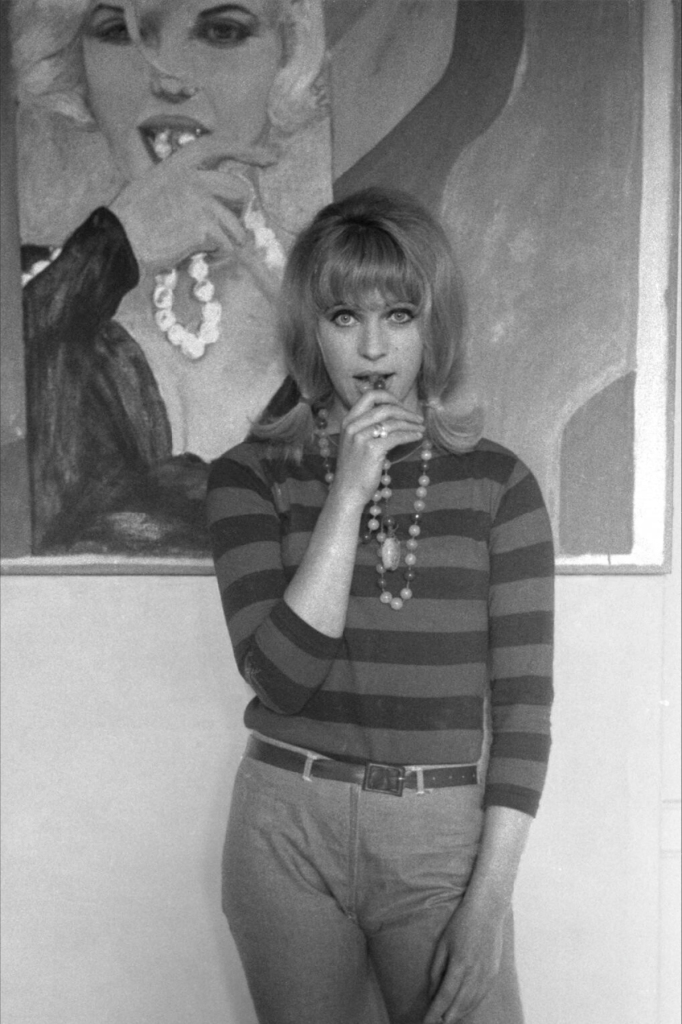
When originally compiling the list of Boty’s paintings for this website I consulted Dr Sue Tate as to whether I should include the “Marilyn with Beads” that Boty is photographed with by John Aston in a print owned by the National Portrait Gallery. Tate was adamant the work no longer existed as she felt sure that Boty had chosen to overpaint it with Colour Her Gone, citing the likelihood that the artist was unhappy with the somewhat crude and overlarge rendering of Monroe’s hand holding the beads – and so it has always been listed accordingly here.
John Aston was commissioned by Men Only to photograph Boty for a feature entitled “Pauline Goes Pop” in the March 1963 issue, ultimately returning for a second session as the first set of prints he showed the magazine wasn’t deemed suitable for its readership.
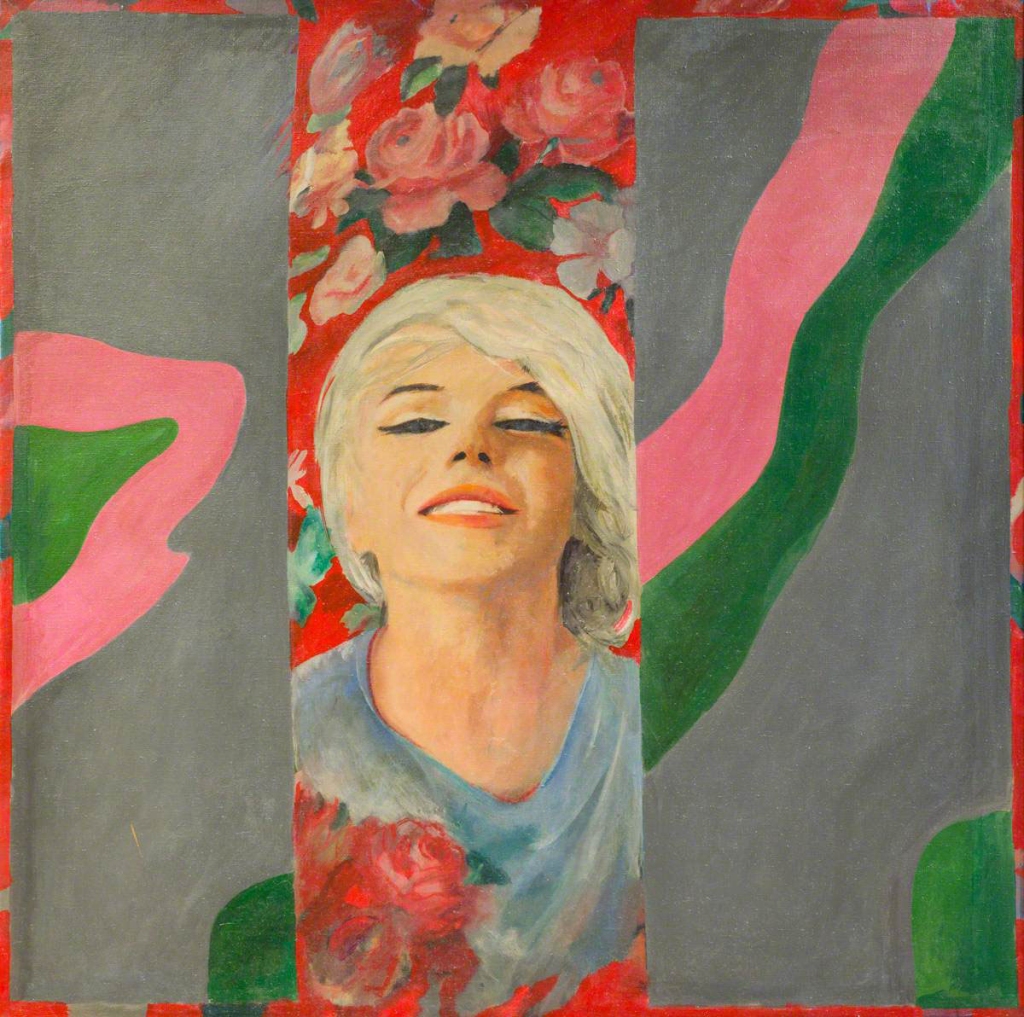
Having had the chance to look again at Colour Her Gone at Gazelli Art House for the first time since 2013 at the exhibition “Pauline Boty: Pop Artist and Woman”, it occurred to me to see what would happen if I montaged the two images together in Photoshop. As per the first image above, the abstract panels looked to me to match nigh on identically, with the central figurative area of the painting maintaining the same width to support Tate’s assertion and I provided Wolverhampton Art Gallery and Gazelli with printouts to propose the theory.
Happily, the two galleries chose to jointly commission a detailed analysis of the work, resulting in the recent announcements from Gazelli Art House and news article from Artnet:
“Exciting news involving Gazelli Art House, Wolverhampton Art Gallery, paulineboty.org, and Dr Sue Tate was recently revealed during Gazelli’s book launch and talk on 23rd January 2024. Together with Wolverhampton Art Gallery, Gazelli Art House conducted a reflectogram (an image taken from beneath an artwork’s surface) validating the ongoing research efforts led by Dr. Sue Tate and Christopher Gregory (paulineboty.org). In a stunning revelation, an entirely new narrative for Pauline Boty’s famed painting Colour Her Gone (1962) has come to light. A reflectogram has shown the iconic portrait of Marilyn Monroe was painted over an earlier image of the star, Marilyn with Beads. This was long thought to be a lost painting, and can be traced back to a 1962 photograph by John Aston. Boty’s Pop Art aesthetic, characterised by broad brushwork and flat perspective, initially suggests a straightforward technique, however reflectography has exposed the intricate evolution of the composition. Painted alterations, particularly to the top of the right-hand colour field panel and the central green ribbon, indicate contemporaneous changes, suggesting a wholesale repainting of the artwork. Pentimenti (visible traces of earlier painting beneath painted layers), showcasing shifts in pearl positions and nostril locations, reflect the artist’s organic design approach. Overall, infrared reflectography (IRR) indicates not just changes in colour panel forms but also hints at alterations to colours used. The transparency of the green upper design in infrared suggests a different initial colour, opening avenues for exploration into pigment variations. The reflectogram invites a closer examination of this artistic transformation, offering a unique glimpse into the complex layers of Colour Her Gone. Colour Her Gone was lent to Gazelli Art House for Pauline Boty: A Portrait (2023-24) by Wolverhampton Art Gallery.
Colour Her Gone; by Pauline Boty, 1962, oil on canvas
‘I had long thought that Marilyn with Beads was not a lost work but lay under Colour Her Gone. The reflectogram gives us conclusive evidence. Here as in other paintings Boty has radically reworked a composition until she had clinched the image that expressed exactly what she wanted to say”. The reflectogram also allows to see, as the report states, “the highly complex development of the composition” and “a high level of planning”, refuting criticisms of slapdash work.’ — Dr. Sue Tate, Freelance Art Historian”
As a footnote both Boty’s source image of Monroe from Town magazine and the paintings’s title originate from the same month of November 1962. In the latter case it was the release date of the single My Colouring Book by among others, Barbra Streisand, with its original closing refrain of “Colour him gone”. Clearly the song made an impression on the artist as she took its title to name another of her works, also including typed fragments of its lyrics, applied using Letraset.
Town magazine, November 1962, published by Corrmarket Press. Cover photo of Marilyn Monroe by George Barris
To see Artnet’s write-up of the report’s confirmation, please see here: [link]
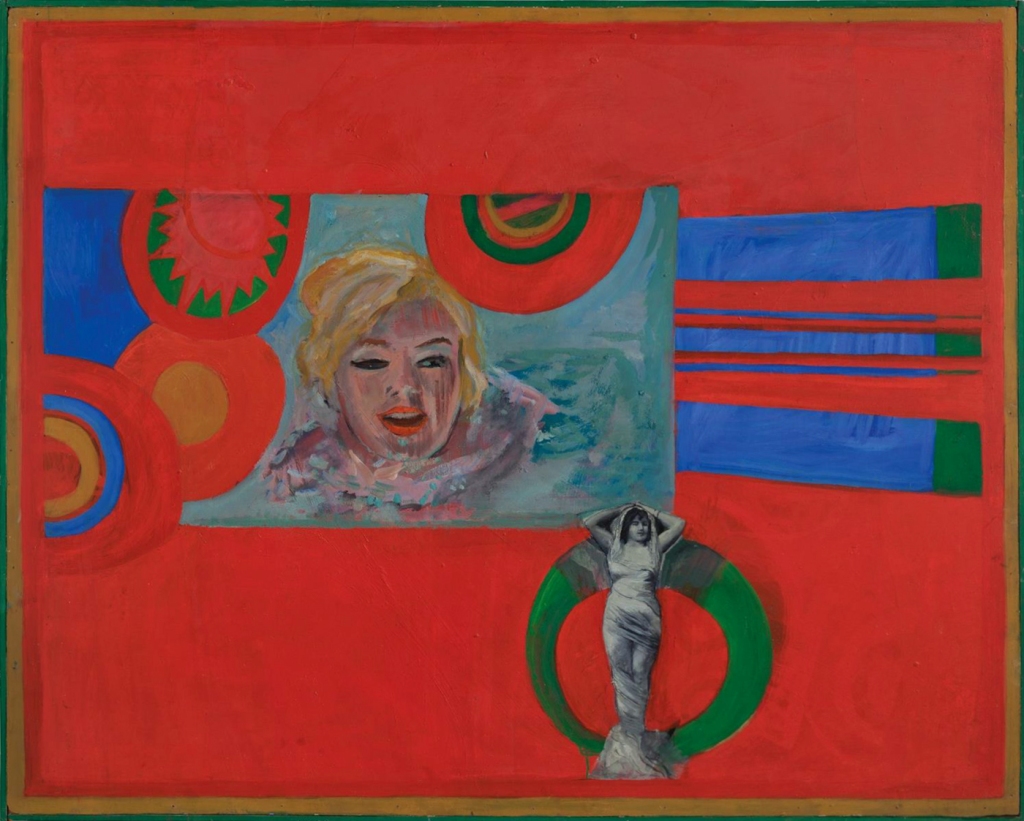
Pauline Boty (1938-1966), 1962, Epitaph to Something’s Gotta Give, oil on board (estimate: £500,000-800,000). Image courtesy of Christies
Christie’s London has announced the following exciting news:
“THE ONLY PORTRAIT OF MARILYN MONROE BY BOTY IN PRIVATE HANDS, we will offer Pauline Boty’s celebratory tribute to Marilyn Monroe, Epitaph to Something’s Gotta Give (1962, estimate: £500,000-800,000), as a leading highlight of the Modern British and Irish Art Evening Sale on 20 March. The painting was gifted to a close friend of Boty’s in 1964 and has remained in the same collection since. One of Pop Art’s founding members, Pauline Boty died prematurely at the age of 28 in 1966. Epitaph to Something’s Gotta Give is one of only around 25 Pop paintings that Boty created and was included in a rare lifetime exhibition at Arthur Jeffress Gallery in London in 1962.
Boty painted two further depictions of Monroe as tributes to the actress following her death, both of which are held in museum collections: Colour Her Gone, 1962 (Wolverhampton Art Gallery) and The Only Blond in the World, 1963 (Tate, London). Epitaph to Something’s Gotta Give will be on view in New York from 9 to 21 February before being exhibited in London from 13 to 20 March.
Angus Granlund, Head of Modern British and Irish Art Evening Sale, Christie’s: ‘Painted in Boty’s distinctive style, Epitaph to Something’s Gotta Give takes the form of a pictorial collage that is entirely rendered in oil paint. A celebration of female empowerment, this is thought to be Boty’s only painting of Monroe painted during the actress’ lifetime. The epitaph referred to in the title relates to the film Something’s Gotta Give shutting down production. The centrepiece of the composition is taken from a photograph published in Life magazine on 22 June 1962, depicting Monroe swimming in a pool on set. Collecting, collating and synthesising mass culture imagery from newspapers, adverts and magazines was central to Boty’s practice. A true polymath, as well as being a ground-breaking artist, Boty was also a talented actress and political activist. She strongly identified with Monroe and is often associated with her. Held in the same private collection since 1964, this rare painting brings together these two celebrated 1960s icons. Christie’s is honoured to present Epitaph to Something’s Gotta Give as a leading highlight of the Modern British and Irish Art Evening Sale and look forward to welcoming clients in New York and London to view this Pop Art masterpiece.’
Pauline Boty was a pioneering artist whose work shaped one of the greatest movements in British art of the 20th century. Within her short lifetime, she created a powerful, vibrant group of works that explored popular culture and left-wing politics, subjects which were coming into sharp focus in the 1960s. Boty studied at the Royal College of Art, the seedbed of the Pop Art movement, where she met, befriended and went on to exhibit with Sir Peter Blake, Derek Boshier, David Hockney, Peter Phillips and Patrick Caulfield. In 1961, she exhibited along with Blake, Geoffrey Reeve and Christine Porter at the A.I.A. Gallery in a group show seen as the very first Pop Art exhibition.”
Lot detail Epitaph to Something’s Gotta Give, 1962 Oil on hardboard 106.5 x 127 cm
Estimate GBP 500,000-800,000
Auction details Modern British and Irish Art Evening Sale 20 March 6:30PM GMT | Live Auction 22673
Viewing New York: from 9–21 February London: from 13–20 March
Further information will both be added to this post and be available here nearer the time: [link]
Spread from exhibition catalogue showing vitrine on display in “Pauline Boty: A Portrait” at Gazelli Art House
Officially launched on 23 January, the publication contains essays and reminiscences by Bridget Boty, Ali Smith CBE FRSL, Prof Lynda Nead FBA, and Dr Sue Tate as well as quotations from influential figures relating to Boty including Natalie Gibson, Derek Boshier, Caroline Coon, Adrian Mibus (Whitford Fine Art) and James Mayor (The Mayor Gallery).
The book also contains individual images of Boty’s works on display, portraits of her by John Aston, Roger Mayne, Lewis Morley, Geoffrey Reeve, John Timbers and Michael Ward, photos of the vitrines, installation shots and more to provide a great memento for anyone visiting and the next best thing to anyone unable to do so.
Further details, including how to purchase the book, are available here: [link]
Exhibition catalogue for “Pauline Boty: A Portrait” at Gazelli Art House with cover photo by Roger Mayne
Pauline Boty, costume for the Bishop, The Balcony, 1961. Gouache on paper. On display in Stage & Screen: Designs from the James L Gordon Collection at the Hunterian Art Gallery. Photo by Colin Malcolm
This free exhibition includes three costumes (for the Bishop, the Judge and the General) and a set design from 1961, all created by Boty for an unrealised production of Jean Genet’s “The Balcony” and runs until 25 February 2024. The University of Glasgow website [location of the Hunterian Art Gallery] has further information, as follows:
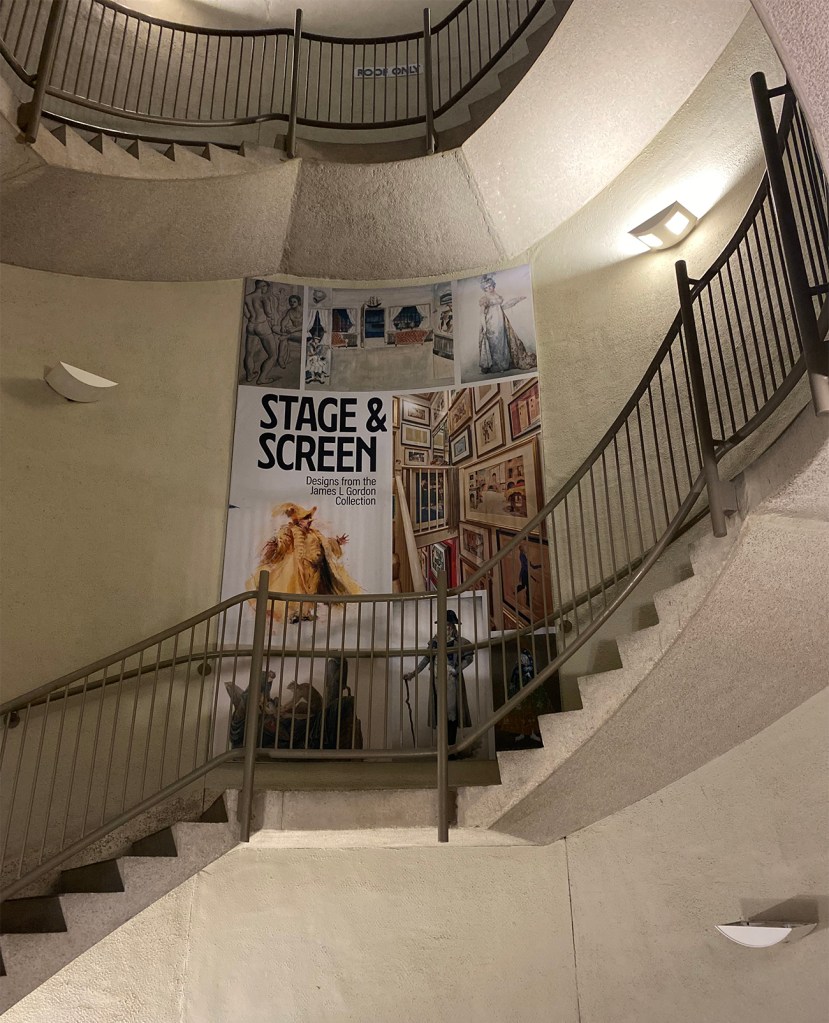
“Stage and Screen features works on paper from the James L Gordon Collection, on show in Scotland for the first time. Covering designs for both theatre and film, this visually engaging exhibition offers a rare glimpse into this unique personal collection of rich and diverse material.
With a few earlier exceptions, the James L Gordon collection comprises set and costume designs for British theatre productions from about 1900 to the 1990s, and British and American designs for film and television from the 1930s onwards. The designs are almost all two-dimensional: drawings, watercolours, paintings and collages, rather than three-dimensional models. The range of material is immense, embracing everything from Shakespeare to pantomime, opera to ballet, Hammer horror to Hollywood musicals and Doctor Who to the Eurovision Song Contest.
Spanning the whole of the 20th century, Stage and Screen includes works by leading artists such as Cecil Beaton and David Hockney and designs for famous productions including Oh! Calcutta!, Hair, Cats, Little Shop of Horrors and The Slab Boys. The exhibition also features costume designs for stars such as Rudolf Nureyev, Richard Burton, Elizabeth Taylor, Judy Garland, Marilyn Monroe, Arnold Schwarzenegger and Grace Jones.
Presented chronologically, by decade, the hundreds of works on display cover a wide range of social and cultural issues, highlighting the history of how they have been represented in the theatre and on screen.
As well as set designs by artists such as Patrick Caulfield, Edward Burra, Paul Nash and Rex Whistler, the exhibition also features costume designs for performers and musicians, often identifiable by the inscriptions or drawings, including Liza Minelli, Elton John, The Jackson Five, Mick Jagger and The Beatles.”
Pauline Boty, costume for the Judge and the General, The Balcony, 1961. Gouache on paper. On display in Stage & Screen: Designs from the James L Gordon Collection at the Hunterian Art Gallery. Photo by Colin Malcolm
Location Hunterian Art Gallery University of Glasgow 82 Hillhead St Glasgow G12 8QQ The Hunterian is part of the University of Glasgow. The Museums, Art Gallery and The Mackintosh House are located on the Gilmorehill campus, 3km west of Glasgow city centre
Gallery Stage and Screen is in Gallery 2, located upstairs. The space is fully accessible via lift
Opening times Tuesday to Sunday 10am–5pm. Closed Monday. Please check the Opening Hours page before visting, here [link]
Further information, including a downloadable list of works, is available here: [link]
Stage & Screen: Designs from the James L Gordon Collection at the Hunterian Art Gallery. Photo by Colin Malcolm
With much thanks to Colin Malcolm for both providing the information about the exhibition and sharing his photos from the event.
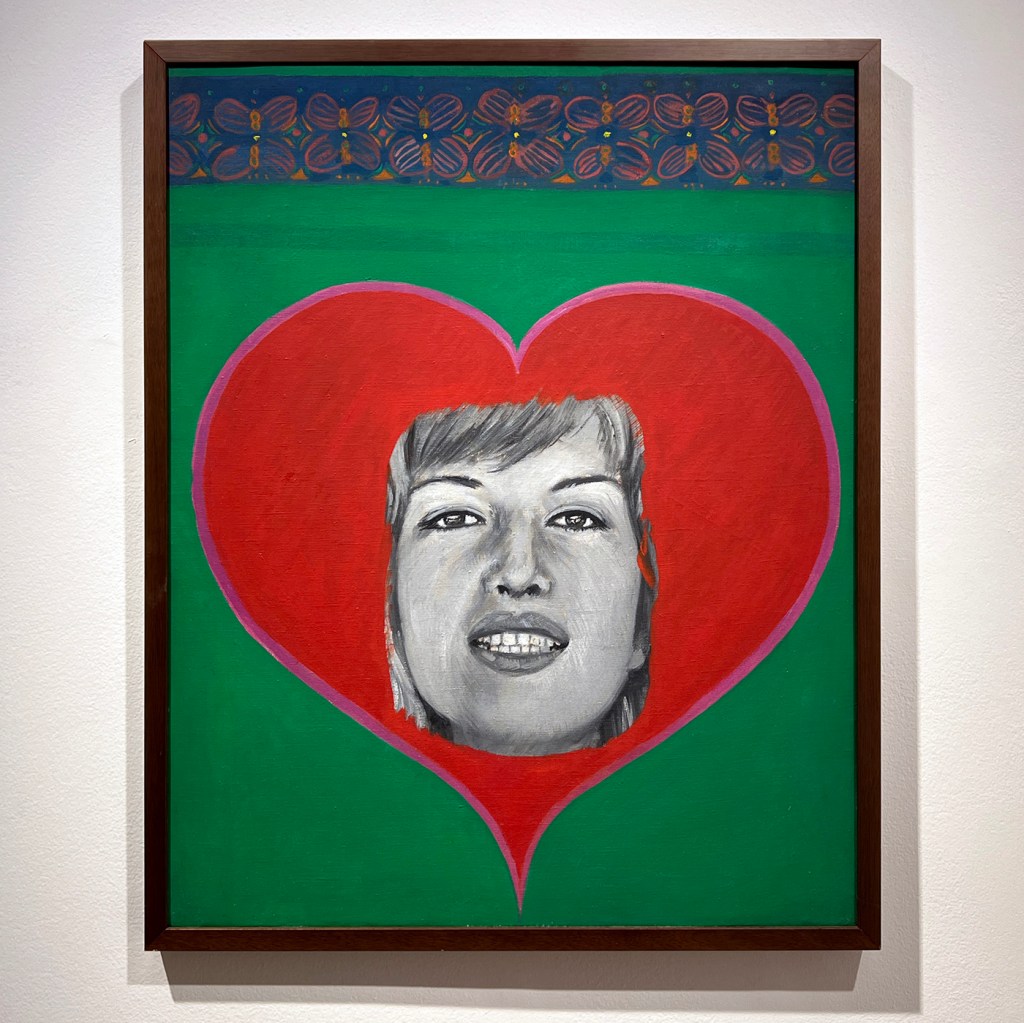
Monica Vitti with Heart, 1963, shown on display in “Pauline Boty: a portrait” at Gazelli Art House
The exhibition has understandably received a considerable amount of favourable reviews and reassessments of Pauline Boty’s life and work so, as promised, we’ve put together a selection of representative quotes with links to the original articles (please note however – some require a subscription to access or are behind a paywall).
“Art historians now broadly agree that Boty’s work stands alongside the best Pop art of the era – and had she not died at the age of only 28, many believe she was on course to become one of the great artists of her generation.” “‘Bold, outrageous’: forgotten star of swinging 60s pop art celebrated with London solo show”, Rob Walker, The Observer, 26 November 2023 [link]
“Boty’s paintings revel in the pleasures of consumerism, in the experience of fandom and infatuation, but with a gaze invested with tenderness towards the reciprocal desires of men and women – in sharp contrast to the ironic fetishisation of women found in other Pop art. This rare show brings together key canvases such as Colour Her Gone and With Love to Jean-Paul Belmondo with earlier collages and works in stained-glass.” “The Top 10 Exhibitions to See in December 2023”, J.J. Charlesworth, ArtReview, 30 November 2023 [link]
“To describe Pauline Boty as a ‘pioneer’ is a bit like calling someone a ‘one-off’. It’s not an adequate description of her in any way.” “Life in colour: Annie Nightingale remembers Pop art painter Pauline Boty”, The Spectator, 2 December 2023 [link]
“There are only 25 recorded Pop period (1962-66) paintings by Pauline Boty, who encapsulated London’s Swinging Sixties with her blonde bob, black eyeliner and colourful, politically attuned art – and five of them are in a show at Gazelli Art House (until February 24).” “Pauline Boty in the Limelight”, Melanie Girlis, Financial Times, 14 December 2023 [link]
“A similar desire to explore femininity and attitudes to female bodies can be found in the work of Pauline Boty. A bold new show at Gazelli Art House – the first posthumous solo exhibition in a decade – platforms the life and work of the British writer, painter and actress who co-founded the 1960s Pop art movement. Pauline Boty: A Portrait digs into Boty’s life and work, showcasing her sensual and erotic works that defiantly reasserted a female perspective, parodying classic tropes associated with femininity and depicting male idols as sexualised pinups.” “A year of culture”, Will Moffitt, Mayfair Times, 1 January 2024 [link]
“‘Boty was a very diverse artist, incorporating collage, lithography, stained glass, painting, and film. Each time, regardless of medium, she would bring in new elements—be it references to pop culture imagery or Victoriana,’ said Gazelli Art House’s Mila Askarova. ‘I think that willingness and ability to experiment, yet still retain a distinctive style, separated her into a league of her own.’” “Pauline Boty’s Sex-Positive Pop Art Is Having a Moment”, Cath Pound, Artsy, 3 January 2024 [link]
“Boty’s transformation from David Frost’s ‘super bird’ to radical Pop artist with unusual ambitions is complete.” “Pauline Boty: Pop art’s only female icon laid bare”, Waldemar Januszczak, Sunday Times, 7 January 2024 [link]
“Boty’s art sizzled with wit, wry humour and social commentary. Her practice was diverse, ranging from stained glass to irreverent paintings and collages of icons such as Elvis and Marilyn Monroe, as well as explorations of race riots in America and the Cuban missile crisis. She subverted expectations, painting men like sex symbols and giving her female subjects sexual freedom.” “Pauline Boty: the dazzling 1960s artist finally having her moment”, Ella Alexander, Harper’s Bazaar, 16 January 2024 [link]
Exhibitiondetails Pauline Boty: A Portrait Exhibition dates: 1 December 2023 — 24 February, 2024
Gazelli Art House, 39 Dover Street, London W1S 4NN Tel: (+44) 01353 660347
Further information, including additional reviews, is available at the Gazelli Art House website here: [link]
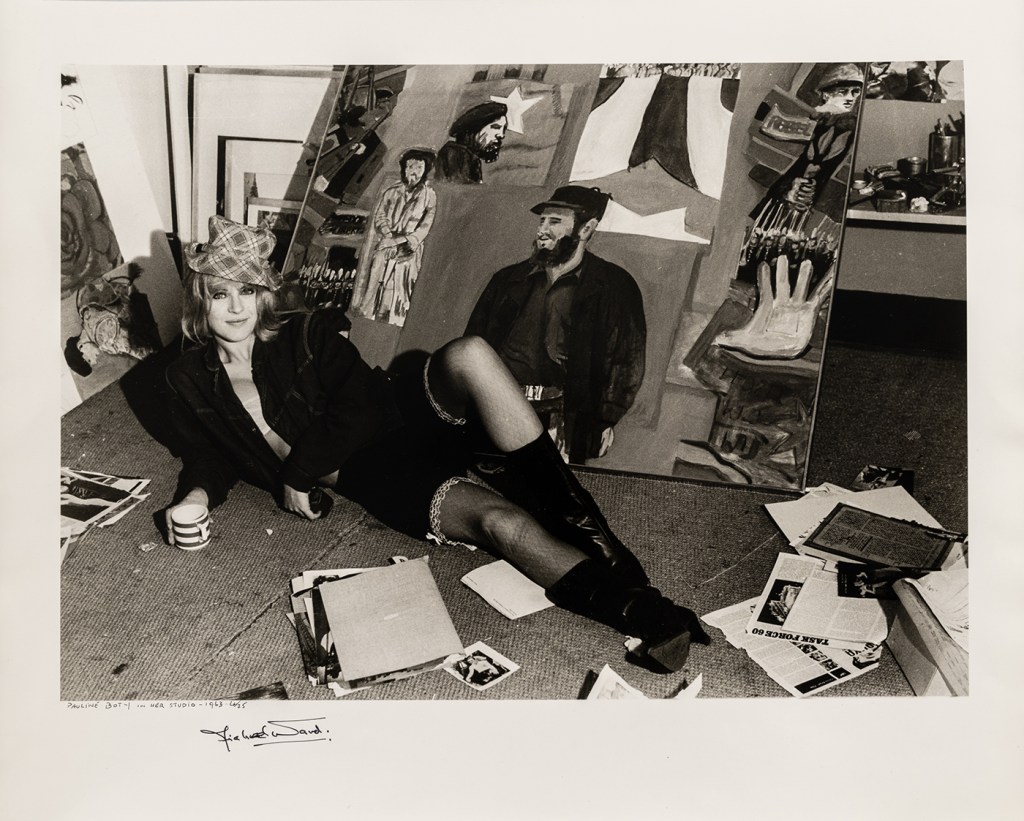
“Untitled (Pauline Boty In Her Studio with ‘July 26’), 1963” by Michael Ward. Vintage photographic print. Ed. 4/25. Courtesy of Elizabeth Seal-Ward for the Michael Ward Archive & Gazelli Art House
In association with the exhibition “Pauline Boty: a portrait” currently showing at Gazelli Art House the gallery has commissioned a series of four C-prints by Michael Ward of Pauline Boty alongside some of her key Pop art paintings in editions of only 25 per image.
Notably, the works shown include Scandal 63 (the only surviving record of her painting based on Lewis Morley’s portrait of Christine Keeler, last seen in the 1960s) and With Love to Jean-Paul Belmondo (an early version of which appeared on the cover of Men Only in 1963 and sold for £1,159,500 at auction in 2022). Pauline Boty was also photographed by, among others, David Bailey, Lewis Morley, Michael Seymour and Roger Mayne and Ward’s images undoubtedly number amongst her best and most well-known portraits
In addition there are a small number of vintage silver gelatin prints by Ward available. Again, of note among these are Boty photographed alongside her lost work July 26, last seen in the 1968 BBC documentary The New Radicals.
“Untitled (‘Men Only’ cover shot), 1963/2023” by Michael Ward. Coloured C-print. Edition of 25. Courtesy of Elizabeth Seal-Ward for the Michael Ward Archive & Gazelli Art House
MICHAEL WARD (B. 1929; UK – D. 2011) Michael Ward rose to prominence as a photographer for the Evening Standard’s Show Page, capturing the emerging talents of his era, including luminaries such as Maggie Smith, Barbara Windsor, Jill Ireland, Jackie Collins, and Julie Christie. In the mid-1960s, Ward joined the Sunday Times where, alongside Bryan Wharton, he became one of the newspaper’s standout photographers. Their collaborative efforts extended beyond portraiture, to current events and news, including the Naples earthquake, the 1968 Paris riots, and the 1974 Turkish-Cypriot war. Ward’s extensive archive has been featured in exhibitions across Britain, with over fifty portraits spanning three decades housed in the National Portrait Gallery [biographical info courtesy of the Gazelli Art House website].
Further information For further information and high resolution previews of the images please click here: [link] Clicking on a thumbnail in each case provides detailed specifications, a scrollable preview and an Enquire button to request further information, including price and availability.
All images Copyright The Artist
Installation shot of the four C-prints by Michael Ward on display in the exhibition “Pauline Boty: a portrait”. The prints are displayed in front of a recreation of part of one of the collaged walls created by Boty. Image courtesy of Gazelli Art House
The section on Boty concludes the programme and starts at approximately 29:10. The BBC website describes the contents of this edition as follows:
“The extraordinary work of the artist Pauline Boty (1938 – 1966) is explored by the curator of a new exhibition, Mila Askarova, and the art historian Lynda Nead.
Paddington director Paul King returns with Wonka starring Timothée Chalamet in the title role. He talks with Samira about exploring the backstory of Willy Wonka and Roald Dahl’s surprising vision for fiction’s greatest confectioner.
Front Row rounds up the best non-fiction books of 2023 with Caroline Sanderson – non-fiction books editor for The Bookseller and chair of judges for the Baillie Gifford Prize in 2022, Stephanie Merritt – critic and novelist, and John Mitchinson – cofounder of Unbound, the independent crowdfunding publisher and co-presenter of literary podcast, Backlisted.” . The programme is available to listen to here [link]
Details Presenter: Samira Ahmed Producer: Paula McGrath Released On: 6 Dec 2023 Available for over a year
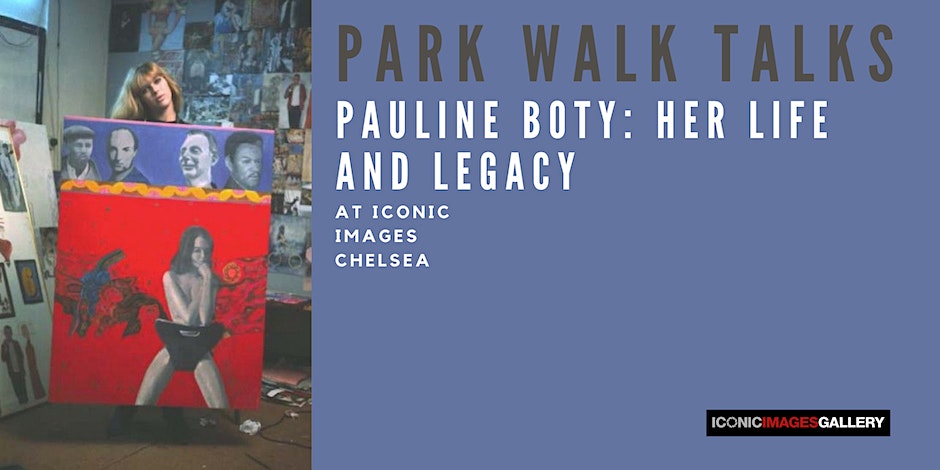
Iconic Images Chelsea have announced the following as the latest in their series of Park Walk Talks: “Artist, feminist, pioneer, provocateur – Pauline Boty was many things in her too-short life. Born into a middle-class Catholic family in 1938, she won a scholarship to the Wimbledon School of Art, attending despite her conservative father’s disapproval. A degree at the Royal College of Art followed, then the post-college years in which Boty became the only established female member of the Pop art movement of the 1960s.
After her untimely death in 1966 at the age of only 28, Boty’s paintings were stored away in a barn on her brother’s farm, and she was largely forgotten for nearly 30 years. In the 1990s her work was rediscovered, provoking new interest in her contribution to Pop art and leading to her inclusion in several group exhibitions as well as a major solo retrospective – in other words, a rewriting of Pop art history.
Join us on Thursday December 7th at the Iconic Images Gallery Chelsea for the latest in our series of Park Walk Talks, where the collector and researcher Christopher Gregory will be exploring Pauline Boty’s brief but fascinating life and legacy. A longtime aficionado of 1960s pop culture, Gregory first encountered Boty’s work in 2011, contributing to her newly published biography and establishing the authorised website paulineboty.org.”
Details Title: Park Walk Talks: Pauline Boty: Her Life and Legacy Location: Iconic Images Chelsea, 13A Park Walk, London SW10 0AJ Date: 7 December 2023 Time: 7:00 pm Tickets are free and can be booked via eventbrite here [link]
Header image shows Pauline Boty with her great lost work “Scandal ’63” photographed by Michael Ward.
Pauline Boty: A Portrait previews 30 November, 6–8PM (GMT) with the Exhibition opening 1December 2023–24 February, 2024 at Gazelli Art House, London.
Colour Her Gone; by Pauline Boty, 1962, oil on canvas
The following information is from the gallery’s website:
“Gazelli Art House celebrates the life and legacy of trailblazing British painter Pauline Boty (1938-1966) in her first posthumous solo exhibition in a decade.
Pauline Boty: A Portrait presents a remarkable opportunity to view Boty’s coveted paintings in unison, alongside a plethora of profound, archival materials. Marking the artist’s third showing at Gazelli Art House, this exhibition continues the gallery’s explorations of Boty’s pivotal and enduring artistic impact. Pauline Boty: A Portrait marks over twenty years since Pauline Boty – The Only Blonde in the World (The Mayor Gallery and Whitford Fine Art, London), and ten years since Pauline Boty: Pop Artist and Woman (Wolverhampton Art Gallery, UK, touring to Pallant House Gallery) curated by Boty specialist and author, Dr Sue Tate. Pauline Boty: A Portrait will be accompanied by a catalogue and talk.
A prominent figure in the British Pop Art movement of the 1960s, Boty waylaid convention with her fearless exploration of femininity, societal norms, politics, and popular culture. Eschewed the esteem of her male contemporaries, and customarily eclipsed by preoccupations with her beauty and the tragedy of her untimely passing, Boty’s artworks are today venerated as climacteric within the cultural discourse surrounding the period.
In the pivotal early work Self Portrait (c.1955), Boty’s instinctual painterly ability delivers an immediate, and human, intensity. Elsewhere, Untitled (Landscape with Rainbow) (1961), seen in Ken Russell’s Young British Artists documentary Pop Goes the Easel (1962), is a rare abstract created concurrently with Boty’s graduation thesis on the rendering of dreams. Here, candied forms drift about an ochre and white expanse with all the turbulence of the ‘swinging’ sixties and the social unrest on the horizon. These bold, early abstracts are, Prof. David Alan Mellor states, ‘inflected by the Cohen brothers and the emblematics of Allen Jones’s rereadings of Dealauny and Kandinsky’.
The influence that film, alongside popular music, played upon Boty’s practice is evidenced in works such as Colour Her Gone (1962), With Love to Jean-Paul Belmondo (1962), and Monica Vitti with Heart (1963). Dr. Sue Tate notes that, in press interviews the artist spoke of a “nostalgia for now” for “present day mythology”. As with myth, Boty’s paintings are laced with symbolism, where a rose may become an unapologetic allegory for female sexuality. These paintings demonstrate the abstract strewn apart and montaged with the figurative, in what would become Boty’s distinctive, painted collage technique.
From popular culture to political musings, in Cuba Si (1963) – named for Chris Marker’s 1961 film of the same name – Boty delivers a complex critique on a Postwar U.S. that denotes the artist’s “ongoing interest in Cuba”, says Author Marc Kristal. When we consider the term ‘Political Pop’ did not emerge until the 1980s, it would be by no means overzealous to suggest Boty was ahead of her time.
Yet, in many ways, Boty was so of her time, so attuned to the charge of change, and perhaps that energy is what resonates still so powerfully today. Boty’s appearances across stage, screen, and radio – including Alfie (1966), and Frank Hilton’s Day of the Prince (1963) at the Royal Court Theatre (for which Boty also designed the programme) – are here exemplified in video footage. In archival photographs within the exhibition we glimpse aspects of the artist’s vivid personality: Boty lies nude atop a chaise-longue, sits contemplative with two black cats, and mimics the actions of her painted subjects.
The significance of this exhibition is not only to draw attention to the radical artworks and ideas of Boty, and the new wave of feminism she undoubtedly heralded, but also to credit the efforts of recent years to rightfully reinstate Boty within the art historical canon.
Pauline Boty signed photo, by John Aston, 1962.
About the Artist Pauline Boty (1938-1966) was born in South London, and embarked on her artistic journey with a scholarship to Wimbledon School of Art in 1954. In 1958, she continued her studies at the Royal College of Art.
Boty’s diverse body of work, encompassing paintings, collages, and stained glass, often depicted individuals she deeply admired, celebrated her unapologetic femininity, and explored themes of female sexuality. As her career progressed, her paintings began to incorporate more overt or implicit critiques of the male-dominated societal norms she confronted, thus shedding light on the inequalities of the “man’s world” in which she navigated.
Boty’s artwork is held in the collections of: The National Portrait Gallery, London; Tate Britain, London; Wolverhampton Art Gallery, Wolverhampton; Stained Glass Museum, Ely; Pallant House Gallery, Chichester; Muzeum Sztuki Łódź, Portugal; Museu Coleção Berardo, Lisboa; Smithsonian American Art Museum, Washington.
About the Gallery Founded in 2010 by Mila Askarova, Gazelli Art House, London brings a fresh perspective to Mayfair – through championing artists from all corners of the globe. Focusing on artists at the height of their practice, the gallery showcases their work through a diverse programme of exhibitions and events. Along with its sister site in Baku, Gazelli Art House specialises in promoting art from Azerbaijan and its neighbours to introduce a greater understanding of the rich linguistic, religious and historical ties that connect these areas to international audiences. In 2015, the gallery further expanded to support artists working in digital art through its online platform: GAZELL.iO, comprising an online Residency programme, NFT drops and collaborations, a dedicated Project Space holding monthly exhibitions, and a permanently installed VR Library.
Acknowledgements For their generosity and insight, Gazelli Art House would like to thank the Estate of Pauline Boty, Wolverhampton Art Gallery, Pallant House Gallery, and other lenders to the exhibition who wish to remain anonymous.”
paulineboty.org is delighted and honoured to be contributing to this exhibition through the loan of a number of pieces of ephemera.
Exhibitiondetails Pauline Boty: A Portrait Preview: 30 November 2023 Time: 6–8pm (UK) Exhibition dates: 1 December 2023 — 24 February, 2024
Gazelli Art House, 39 Dover Street, London W1S 4NN Tel: (+44) 01353 660347
Further information is available at the Gazelli Art House website here: [link]