Pauline Boty: A Portrait previews 30 November, 6–8 PM (GMT) with the Exhibition opening 1 December 2023–24 February, 2024 at Gazelli Art House, London.
The following information is from the gallery’s website:
“Gazelli Art House celebrates the life and legacy of trailblazing British painter Pauline Boty (1938-1966) in her first posthumous solo exhibition in a decade.
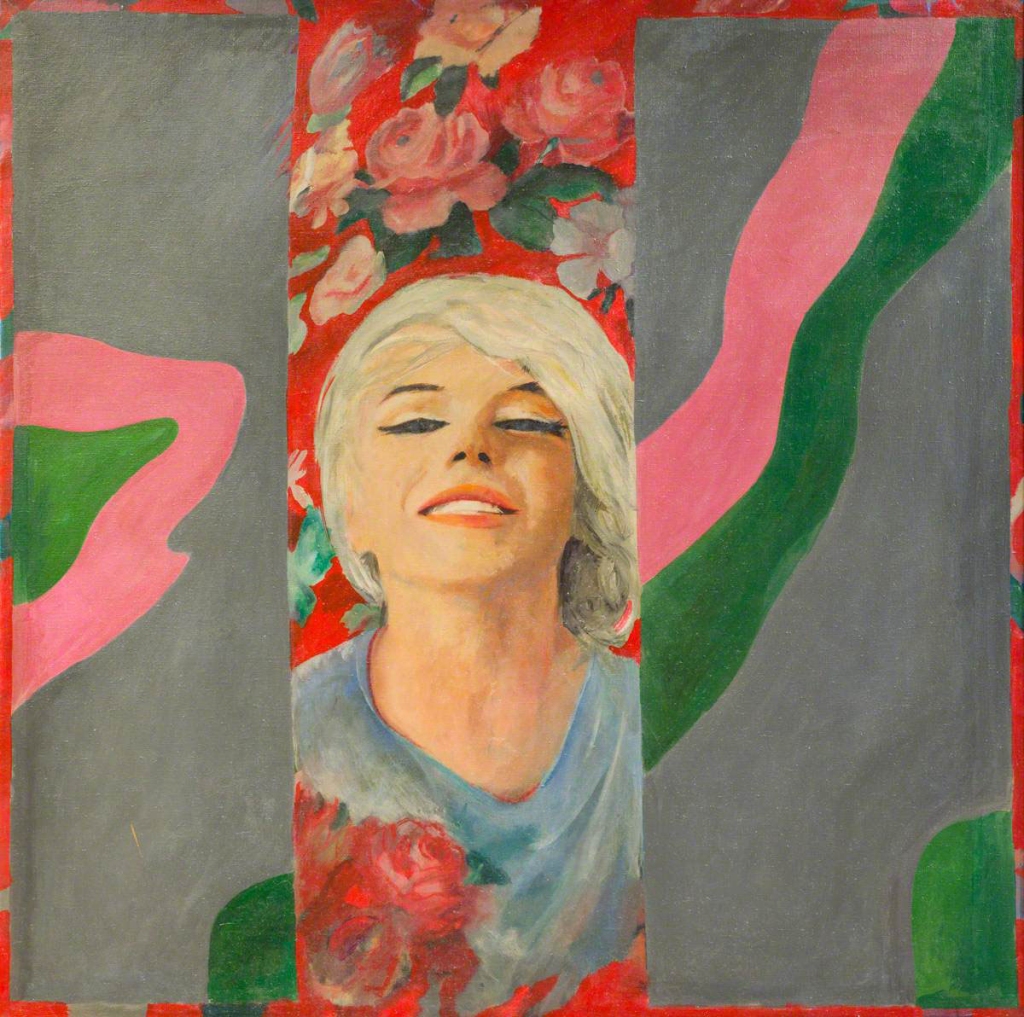
Pauline Boty: A Portrait presents a remarkable opportunity to view Boty’s coveted paintings in unison, alongside a plethora of profound, archival materials. Marking the artist’s third showing at Gazelli Art House, this exhibition continues the gallery’s explorations of Boty’s pivotal and enduring artistic impact. Pauline Boty: A Portrait marks over twenty years since Pauline Boty – The Only Blonde in the World (The Mayor Gallery and Whitford Fine Art, London), and ten years since Pauline Boty: Pop Artist and Woman (Wolverhampton Art Gallery, UK, touring to Pallant House Gallery) curated by Boty specialist and author, Dr Sue Tate. Pauline Boty: A Portrait will be accompanied by a catalogue and talk.
A prominent figure in the British Pop Art movement of the 1960s, Boty waylaid convention with her fearless exploration of femininity, societal norms, politics, and popular culture. Eschewed the esteem of her male contemporaries, and customarily eclipsed by preoccupations with her beauty and the tragedy of her untimely passing, Boty’s artworks are today venerated as climacteric within the cultural discourse surrounding the period.
In the pivotal early work Self Portrait (c.1955), Boty’s instinctual painterly ability delivers an immediate, and human, intensity. Elsewhere, Untitled (Landscape with Rainbow) (1961), seen in Ken Russell’s Young British Artists documentary Pop Goes the Easel (1962), is a rare abstract created concurrently with Boty’s graduation thesis on the rendering of dreams. Here, candied forms drift about an ochre and white expanse with all the turbulence of the ‘swinging’ sixties and the social unrest on the horizon. These bold, early abstracts are, Prof. David Alan Mellor states, ‘inflected by the Cohen brothers and the emblematics of Allen Jones’s rereadings of Dealauny and Kandinsky’.
The influence that film, alongside popular music, played upon Boty’s practice is evidenced in works such as Colour Her Gone (1962), With Love to Jean-Paul Belmondo (1962), and Monica Vitti with Heart (1963). Dr. Sue Tate notes that, in press interviews the artist spoke of a “nostalgia for now” for “present day mythology”. As with myth, Boty’s paintings are laced with symbolism, where a rose may become an unapologetic allegory for female sexuality. These paintings demonstrate the abstract strewn apart and montaged with the figurative, in what would become Boty’s distinctive, painted collage technique.
From popular culture to political musings, in Cuba Si (1963) – named for Chris Marker’s 1961 film of the same name – Boty delivers a complex critique on a Postwar U.S. that denotes the artist’s “ongoing interest in Cuba”, says Author Marc Kristal. When we consider the term ‘Political Pop’ did not emerge until the 1980s, it would be by no means overzealous to suggest Boty was ahead of her time.
Yet, in many ways, Boty was so of her time, so attuned to the charge of change, and perhaps that energy is what resonates still so powerfully today. Boty’s appearances across stage, screen, and radio – including Alfie (1966), and Frank Hilton’s Day of the Prince (1963) at the Royal Court Theatre (for which Boty also designed the programme) – are here exemplified in video footage. In archival photographs within the exhibition we glimpse aspects of the artist’s vivid personality: Boty lies nude atop a chaise-longue, sits contemplative with two black cats, and mimics the actions of her painted subjects.
The significance of this exhibition is not only to draw attention to the radical artworks and ideas of Boty, and the new wave of feminism she undoubtedly heralded, but also to credit the efforts of recent years to rightfully reinstate Boty within the art historical canon.

About the Artist
Pauline Boty (1938-1966) was born in South London, and embarked on her artistic journey with a scholarship to Wimbledon School of Art in 1954. In 1958, she continued her studies at the Royal College of Art.
Boty’s diverse body of work, encompassing paintings, collages, and stained glass, often depicted individuals she deeply admired, celebrated her unapologetic femininity, and explored themes of female sexuality. As her career progressed, her paintings began to incorporate more overt or implicit critiques of the male-dominated societal norms she confronted, thus shedding light on the inequalities of the “man’s world” in which she navigated.
Boty’s artwork is held in the collections of: The National Portrait Gallery, London; Tate Britain, London; Wolverhampton Art Gallery, Wolverhampton; Stained Glass Museum, Ely; Pallant House Gallery, Chichester; Muzeum Sztuki Łódź, Portugal; Museu Coleção Berardo, Lisboa; Smithsonian American Art Museum, Washington.
About the Gallery
Founded in 2010 by Mila Askarova, Gazelli Art House, London brings a fresh perspective to Mayfair – through championing artists from all corners of the globe. Focusing on artists at the height of their practice, the gallery showcases their work through a diverse programme of exhibitions and events. Along with its sister site in Baku, Gazelli Art House specialises in promoting art from Azerbaijan and its neighbours to introduce a greater understanding of the rich linguistic, religious and historical ties that connect these areas to international audiences. In 2015, the gallery further expanded to support artists working in digital art through its online platform: GAZELL.iO, comprising an online Residency programme, NFT drops and collaborations, a dedicated Project Space holding monthly exhibitions, and a permanently installed VR Library.
Acknowledgements
For their generosity and insight, Gazelli Art House would like to thank the Estate of Pauline Boty, Wolverhampton Art Gallery, Pallant House Gallery, and other lenders to the exhibition who wish to remain anonymous.”
paulineboty.org is delighted and honoured to be contributing to this exhibition through the loan of a number of pieces of ephemera.
Exhibition details
Pauline Boty: A Portrait
Preview: 30 November 2023
Time: 6–8pm (UK)
Exhibition dates: 1 December 2023 — 24 February, 2024
Gazelli Art House,
39 Dover Street,
London W1S 4NN
Tel: (+44) 01353 660347
Further information is available at the Gazelli Art House website here: [link]
 Pauline Boty