
Pauline Boty’s collage Picture Show from c. 1960/61 (mixed media on cardboard; collage, gold gilt paint, sequins) was first exhibited at the 1961 exhibition Blake, Boty, Porter, Reeve, AIA Gallery in London. Thanks to Ken Russell’s 1962 BBC documentary “Pop Goes the Easel” we also have a record of Boty’s thinking behind her work and descriptions of some of its sources.
In her preproduction interview she described to Russell the content of a number of her collages to appear within the programme. In the case of Picture Show she explained how she had had the idea of a gallery with people looking at pictures, that in some cases the pictures might be alive, how the pen was Beethoven’s and that the image of Giorgos Grivas was from a memorial. She went on to identify Roosevelt, Colette, “a lovely sort of Goya portrait”, Rambeau and Proust with Madame Pompadour and Madame Recamier at the bottom “all quite alike”, Marilyn Monroe, two friends of Colette’s “who were great beauties of their time”, and 1920s debutantes going off to the palace.
In the documentary itself she is filmed describing the collages to Peter Blake. Where present those descriptions have been added below.
In the key below those items still requiring further identification are marked accordingly, and as ever, any assistance in identifying them would be greatly appreciated and will be credited accordingly.
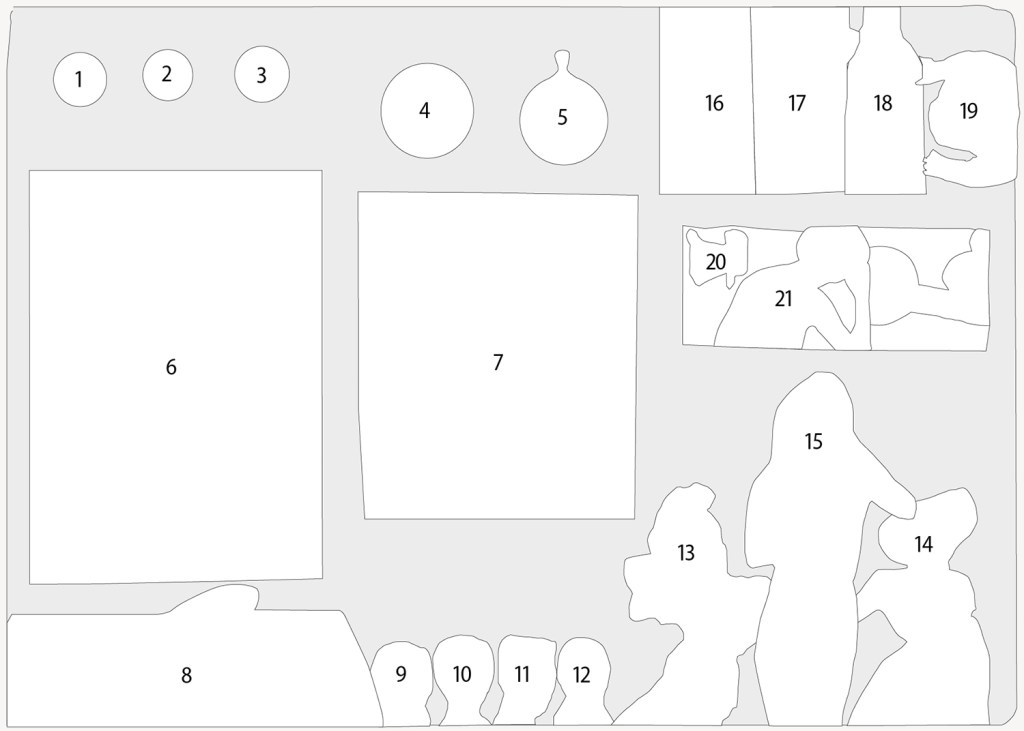
[1–3] Franklin D. Roosevelt
Franklin Delano Roosevelt (January 30, 1882 – April 12, 1945) was the the longest-serving president of the United States, from 1933 until his death in 1945, and the only president to serve more than two terms.
In “Pop Goes the Easel” Boty states “There’s Franklin D. Roosevelt growing older. They’re badges actually – they were.”
Wikipedia entry here [link]
[4] Possibly Earl Holliman
Henry Earl Holliman (September 11, 1928 – November 25, 2024) was an American actor, animal rights activist, and singer known for his many character roles in films and dramas in the 1950s and 1960s.
He appeared in the debut episode of “The Twilight Zone” which aired on October 2, 1959.
Wikipedia entry here [link]
[5] Colette
Sidonie-Gabrielle Colette (French: 28 January 1873 – 3 August 1954) was a French author, actor, and journalist, best known for her 1944 novella Gigi.
Wikipedia entry here [link]
[6] Giorgos Grivas
Georgios Grivas (Greek: 6 June 1897 – 27 January 1974) was the Cypriot leader of the EOKA paramilitary organisations and one of the main actors in the Cypriot War of Independence.
Wikipedia entry here [link]
[7] Doña Isabel de Porcel, Oil on canvas, before 1805, by Francisco de Goya
Francisco José de Goya y Lucientes (Spanish: 30 March 1746 – 16 April 1828) was a romantic painter and printmaker, widely considered to be the most important Spanish artist of his time.
Wikipedia entry here [link]
[8] Beethoven’s pen
The works of German composer and pianist Ludwig van Beethoven (baptised 17 December 1770 – 26 March 1827) span the transition from the Classical period to the Romantic era.
Wikipedia entry here [link]
[9] Arthur Rimbaud
Jean Nicolas Arthur Rimbaud (20 October 1854 – 10 November 1891) was a French poet whose transgressive and surreal themes prefigured surrealism.
The image’s source appears to be Henri Fantin-Latour’s 1872 painting By the table.
Wikipedia entry here [link]
[10] Madame de Pompadour
Jeanne Antoinette Poisson, Marquise de Pompadour (French: 29 December 1721 – 15 April 1764), was a member of the French court and for a period chief mistress of King Louis XV. She was a major patron of architecture, the decorative arts and philosophes of the Enlightenment, including Voltaire.
Wikipedia entry here [link]
[11] Juliette Récamier
Jeanne Françoise Julie Adélaïde Récamier (French: 3 December 1777 – 11 May 1849) was a socialite whose salon drew people from the leading literary and political circles of early 19th-century Paris. She cultivated a public persona as a great beauty.
The image’s source appears to be Jacques-Louis David’s 1800 work Portrait of Madame Récamier.
Wikipedia entry here [link]
[12] Marcel Proust
Valentin Louis Georges Eugène Marcel Proust (10 July 1871 – 18 November 1922) was a French novelist, critic, and essayist whose works include the epic À la recherche du temps perdu which had been read by Boty.
Wikipedia entry here [link]
[13] Probably Émilie Marie Bouchaud, “Polaire”
Émilie Marie Bouchaud (French: 14 May 1874 – 14 October 1939), better known by her stage name Polaire, was a singer and actress whose first major appearance was in a play based on Colette’s Claudine à Paris.
In “Pop Goes the Easel” Boty states “And then there’s two friends of Colette’s who were great beauties of their time.”
Wikipedia entry here [link]
[14] Possibly Georgie Raoul-Duval
Jeannie Urquhart or Georgie Raoul–Duval (3 July 1866 – 3 November 1913) was an American writer, playwright, and socialite involved in a ménage-a-trois with Colette and Colette’s first husband, Henry Gauthier-Villars.
As noted above in “Pop Goes the Easel” Boty states “And then there’s two friends of Colette’s who were great beauties of their time.”
Wikipedia entry here [link]
[15] Marilyn Monroe
Marilyn Monroe, born Norma Jeane Mortenson; (June 1, 1926 – August 4, 1962), was an American actor and model. She became one of the iconic figures of the 1950s and early 1960s.
Pauline Boty closely identified with Monroe and painted three large portraits of the actor in addition to this collage.
Wikipedia entry here [link]
[16–17] 1920’s debutantes
Debutantes were so named as they were the young aristocratic woman presented to society at a formal “debut”, King George III organising the first Queen Charlotte’s Ball in 1780 with the presentation of debutantes at royal court.
Wikipedia entry here [link]
[18] ”Big Ben”
In “Pop Goes the Easel” Boty states “And then there’s a baby holding up Big Ben.” Whilst similar in appearance, this does not appear to be the famous clock tower which stands at the north end of the Palace of Westminster in London however.
Wikipedia entry here [link]
[19] “Rubens baby”
In “Pop Goes the Easel” Boty states “That’s one of those Rubens babies” but the source is in fact Georgiana, Duchess of Devonshire with her Infant Daughter Lady Georgiana Cavendish by Joshua Reynolds, 1784.
Wikiart entry here [link]
[20] Dog from The Arnolfini Portrait by Jan van Eyck, 1434
Considered one of the most original and complex paintings in Western art, the work is a full-length double portrait, believed to depict Italian merchant Giovanni di Nicolao Arnolfini and his wife.
Wikipedia entry here [link]
[21] Lina Cavalieri
Natalina “Lina” Cavalieri (25 December 1874 – 7 February 1944) was an Italian operatic dramatic soprano, actress, and monologist. At one time she was known as “the most beautiful woman in the world”.
Wikiart entry here [link]
All further comments, corrections and clarifications to the information above would be greatly appreciated via the Contact form here please: [link]
Acknowledgements
With thanks to Gavin @comftybold [4], Sue Tate [20] and Fraser Donachie [21].
 Pauline Boty