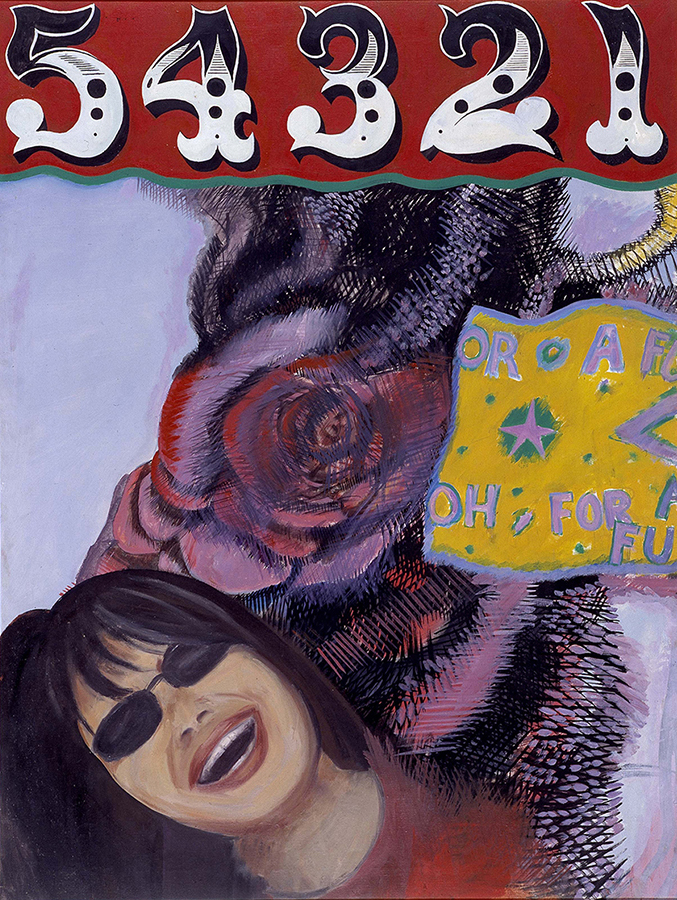
Despite understandable confusion to the contrary, Pauline Boty and Manfred Mann’s works “5-4-3-2-1” are almost certainly unconnected, even though her painting shares the same title as the theme tune to “Ready Steady Go!”, its seemingly “Cathy McGowanesque” figure and her having danced with Derek Boshier at the recording of the programme on numerous occasions!
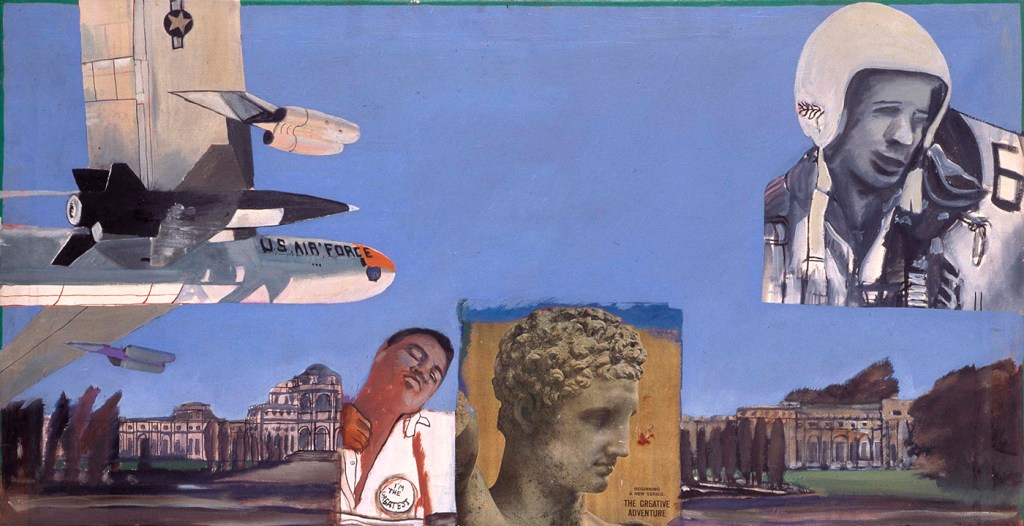
Adam Smith (who wrote a yet as unpublished biography on Boty) felt the title was much more likely to relate to the numerous countdowns taking place at the time in the USA during the Space Race (the same article Boty used from a 1962 Sunday Times Magazine for her source image of B52 and X-15 in her 1964 work It’s a Man’s World I for example contains the countdown to the latter’s release: “Five-four-three-two-one drop!”).
Boty notably followed her countdown with the exortation “OH, FOR A FU…” alongside a five pointed star within roundel not dissimilar to the US Air Force’s National Star Insignia on It’s a Man’s World I’s B52.
Andy Neill, author of the definitive history Ready Steady Go: The Weekend Starts Here, first bought this to my attention in an email exchange during his researching of the book when he sent the following: “A common misconception but Pauline’s painting was not inspired by RSG! She painted it in 1963 and 5-4-3-2-1 did not become RSG!’s theme tune until January 1964.”
.
Having since looked at the timelines for painting, song, programme, presenter and more, these then are the key dates as far as I can ascertain:
26 July 1963 Manfred Mann’s first single Why Should We Not released, which failed to chart.
9 August First episode of “Ready Steady Go”. Pauline Boty and Georgina Nicholson demonstrated The Twist after which Joe Loss judged a dancing competition (which Boty won!) with LPs awarded as prizes. The programme’s theme song at the time was Wipe Out by the Surfaris.
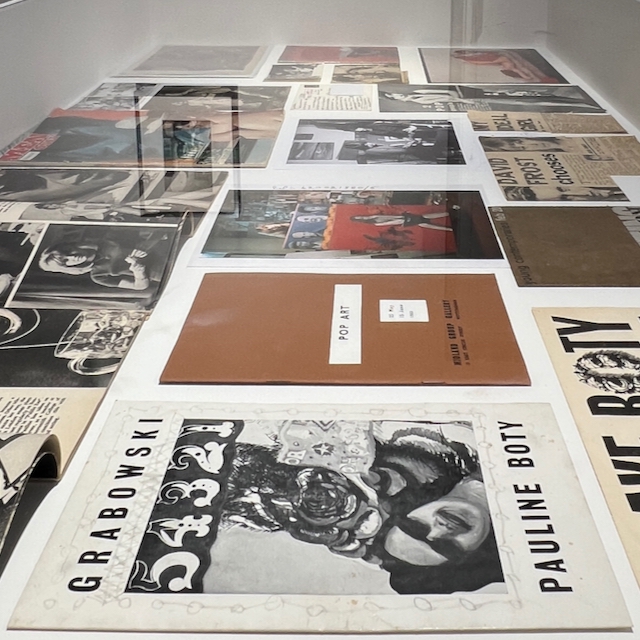
10 September Boty’s solo show opened at the Grabowski Galley in London. This included and listed 5-4-3-2-1 by name and also featured it in a yet to be complete state on the exhibition catalogue’s cover (which would, of course, have had to have been photographed, designed and printed some time prior to the show).
October Elkan Allan (head of entertainment at Associated-Rediffusion and creator and producer of RSG!) placed ads seeking “teenage advisers” to the show. Cathy McGowan and Michael Aldred were ultimately chosen from hundreds of hopefuls who applied.
25 October (Episode 12) Neill records Cathy McGowan as being present at the show but uncertain as to whether or not she appeared on camera.
8 November Manfred Mann’s second single Cock-A-Hoop released, which failed to chart.
29 November (Episode 17) First appearance of Manfred Mann on RSG! where they performed Cock-A-Hoop.
November/December Francis Hitching, one of the show’s producers, approached the band and asked if they would like to write a new theme song to accompany new visuals being created for its titles (as recalled in Neill’s book by Manfred Mann and Paul Jones).
Mann remembered coming up with its title and 5-4-3-2-1 idea, “like a rocket countdown” and Jones noted how strict the rules were that they had to work to, including the song’s tempo and beat and how many seconds of instrumental were required before the vocal came in.
It was also requested that the lyrics be similar to Cock-A-Hoop and the commission was described as being more akin to writing a TV commercial than a conventional track.
6 December (Episode 18) First appearance on RSG! of Cathy McGowan as presenter

17 December 5-4-3-2-1 recorded at Abbey Road Studios, London
10 January 1964 5-4-3-2-1 released as a single (four months to the day after Boty’s solo show opening).
17 January 1964 (Episode 24) First use of 5-4-3-2-1 as the new theme tune for RSG!
In conclusion, would suggest that firstly Boty couldn’t have known that Cathy McGowan was going to be the programme’s presenter when she created her work and secondly, unless she had prior knowledge that the show’s theme tune was going to be changed later in the year and that the band were going to be commissioned to write it, would have been unaware of the relevance of Manfred Mann’s forthcoming single to the programme.
 Pauline Boty